MCQ
Following are four differrent relations about displacement, velocity and acceleration for the motion of a particle in general. Choose the incorrect one $(s):$
  • A
    $\text{v}_\text{av}=\frac{1}2\big[\text{v}(\text{t}_1)+\text{v}(\text{t}_2)\big]$
  • B
    $\text{v}_\text{av}=\frac{r(\text{t}_2)-\text{r}(\text{t}_1)}{\text{t}_2-\text{t}_1}$
  • C
    $\text{r}=\frac{1}2(\text{v}(\text{t}_2)-\text{v}(\text{t}_1))(\text{t}_2-\text{t}_1)$
  • Both $A$ and $C$

Answer

Correct option: D.
Both $A$ and $C$
When an object covers a displacement $\Delta\text{r}$ in time $\Delta\text{t},$ its average velocity is given by $\vec{\text{v}}_\text{avg}=\frac{\overrightarrow{\Delta\text{r}}}{\Delta\text{t}}=\frac{\text{r}_2-\text{r}_1}{\text{t}_2-\text{t}_1}$ where $r_1$ and $r_2$ are position vectors corresponding to time $t_1$ and $t_2$.
If the velocity of an object changes from $v_1$ to $v_2$ in time $\Delta\text{t},$ average acceleration is given by
$\text{a}_\text{av}=\frac{\Delta\text{v}}{\Delta\text{t}}=\frac{\text{v}_2-\text{v}_1}{\text{t}_2-\text{t}_1}$
But, when acceleration is non$-$uniform,
$\text{v}_\text{av}\neq\frac{\text{v}_1+\text{v}_2}{2}$
Option $(c)$ is similar to the relation $\vec{\text{r}}=\frac{1}2\text{at}^2$ which is not correct if initial velocity is given.
So $(b)$ and $(c)$ are the correct relations for the uniform acceleration.

Need a full question paper?

Generate a complete, print-ready paper with questions like this in minutes — across 16+ boards, with answer keys.

Start Generating Free

Similar questions

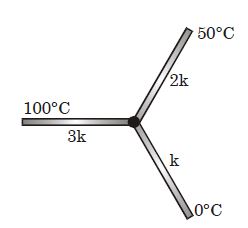
Three rods of the same dimensions have thermal conductivities $3k, 2k$ and $k$. They are arranged as shown, with their ends at $100\,^oC, 50\,^oC$ and $0\,^oC$. The temperature of their junction is
A car, moving with a speed of $50 \,km/hr$, can be stopped by brakes after at least $6\,m$. If the same car is moving at a speed of $100 \,km/hr$, the minimum stopping distance is..........$m$
$c_P$ and $c_V$ are specific heats at constant pressure and constant volume respectively. It is observed that

$c_P - c_V = a$ for hydrogen gas

$c_P - c_V = b$ for nitrogen gas

The correct relation between $a$ and $b$ is

A spaceship orbits around a planet at a height of $20\,km$ from its surface. Assuming that only gravitational field of the plant acts on the spaceship. What will be the number of complete revolutions made by the spaceship in $24\,hours$ around the plane? [Given: Mass of plane $= 8 \times 10^{22}\,kg,$ Radius of planet $= 2\times 10^6\,m,$ Gravitational constant $G = 6.67\times 10^{-11}\,Mn^2/kg^2$ ]
A person aiming to reach the exactly opposite point on the bank of a stream is swimming with a speed of $0.5\, m/s$ at an angle of $120^°$ with the direction of flow of water. The speed of water in the stream is..........$m/s$
The fundamental frequency of a sonometer wire of length $l$ is $n_0$ . A bridge is now introduced at a distance of $\Delta l ( < < l)$ from the centre of the wire. The lengths of wire on the two sides of the bridge are now vibrated in their fundamental modes. Then, the beat frequency nearly is
$A$ solid sphere with a velocity (of centre of mass) $v$ and angular velocity $\omega$ is gently placed on a rough horizontal surface. The frictional force on the sphere:
If momentum is increased by $20\%$ , then K.E. increases by ........... $\%$
A body of mass $m_1$ exerts a force on another body of mass $m_2$. If the magnitude of acceleration of $m_2$ is $a_2$, then the magnitude of the acceleration of $m_1$ is (considering only two bodies in space)
The force constant of a wire is $k$  and that of another wire is $2k.$ When both the wires are stretched through same distance, then the work done