MCQ
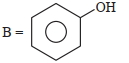
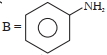
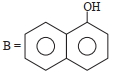
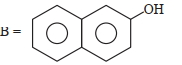
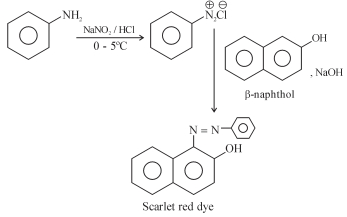
Following is a confirmatory test for aromatic primary amines. Identify reagent $(A)$ and $(B)$
  • A
    $\mathrm{A}=\mathrm{HNO}_3 / \mathrm{H}_2 \mathrm{SO}_4$ 
  • B
    $\mathrm{A}=\mathrm{NaNO}_2+\mathrm{HCl}, 0-5^{\circ} \mathrm{C}$
  • C
    $\mathrm{A}=\mathrm{NaNO}_2+\mathrm{HCl}, 0-5^{\circ} \mathrm{C}$ 
  • $\mathrm{A}=\mathrm{NaNO}_2+\mathrm{HCl}, 0-5^{\circ} \mathrm{C}$ 

Answer

Correct option: D.
$\mathrm{A}=\mathrm{NaNO}_2+\mathrm{HCl}, 0-5^{\circ} \mathrm{C}$ 
d

Need a full question paper?

Generate a complete, print-ready paper with questions like this in minutes — across 16+ boards, with answer keys.

Start Generating Free

Similar questions

How many primary alcohols (including stereoisomers) are possible with formula $C_5H_{12}O$ ?
The electronic configuration of three elements $A,B$ and $C$ are given below. Stable form of $C$ may be represented by the formula

$A : 1s^2\, 2s^2\, 2p^6$

$B : 1s^2\, 2s^2\, 2p^6\, 3s^2\, 3p^3$

$C : 1s^2\, 2s^2\, 2p^6\, 3s^2\, 3p^5$

A reaction takes place in three steps with individual rate constant and activation energy as follows 

     Rate constant     Activation energy
 Step $1$        $k_1$ $E_{a1} = 180\ kJ/mol$
 Step $2$        $k_2$ $E_{a2} = 80\ kJ/mol$
 Step $3$        $k_3$ $E_{a3} = 50\ kJ/mol$

If overall rate constant, $k = {\left( {\frac{{{k_1}{k_2}}}{{{k_3}}}} \right)^{2/3}}$  ,then overall activation energy of the reaction will be  .......... $ kJ/mol$

Product $(C)$ of the reaction is
What is prefix of ester ?
Which is incorrect numbering in the following compounds as per $IUPAC$ rules ?
In the reaction,$2KMn{O_4} + 16HCl \to 5C{l_2} + 2MnC{l_2} + 2KCl + 8{H_2}O$the reduction product is
The coordination number of $Pt$ in ${\left[ {Pt{{\left( {N{H_3}} \right)}_4}C{l_2}} \right]^{ + + }}$ ion is
Which of the following acid possesses oxidising, reducing and complex forming properties
$p$-Amino- $N, N$-dimethylaniline is added to a strongly acidic solution of ${X}$. The resulting solution is treated with a few drops of aqueous solution of ${Y}$ to yield blue coloration due to the formation of methylene blue. Treatment of the aqueous solution of ${Y}$ with the reagent potassium hexacyanoferrate$(II)$ leads to the formation of an intense blue precipitate. The precipitate dissolves on excess addition of the reagent. Similarly, treatment of the solution of ${Y}$ with the solution of potassium hexacyanoferrate$(III)$ leads to a brown coloration due to the formation of ${Z}$.

$1.$ The compound ${X}$ is

$(A)$ $\mathrm{NaNO}_3$ $(B)$ $\mathrm{NaCl}$ $(C)$ $\mathrm{Na}_2 \mathrm{SO}_4$ $(D)$ $\mathrm{Na}_2 \mathrm{~S}$

$2.$ The compound ${Y}$ is

$(A)$ $\mathrm{MgCl}_2$ $(B)$ $\mathrm{FeCl}_2$ $(C)$ $\mathrm{FeCl}_3$ $(D)$ $\mathrm{ZnCl}_2$

$3.$ The compound ${Z}$ is

$(A)$ $\left.\mathrm{Mg}_2 \mid \mathrm{Fe}(\mathrm{CN})_6\right]$ $(B)$ $\operatorname{Fe}\left[\mathrm{Fe}(\mathrm{CN})_6\right]$

$(C)$ $\mathrm{Fe}_4\left[\mathrm{Fe}(\mathrm{CN})_6\right]_3$ $(D)$ $\mathrm{K}_2 \mathrm{Zn}_3\left[\mathrm{Fe}(\mathrm{CN})_6\right]_2$

Give the answer question $1,2$ and $3.$