MCQ
Following limiting molar conductivities are given as

$\lambda_{\mathrm{m}\left(\mathrm{H}_{2} \mathrm{SO}_{4}\right)}^{0}=\mathrm{x} \;\mathrm{S}\; \mathrm{cm}^{2} \mathrm{mol}^{-1}$

$\lambda_{\mathrm{m}\left(\mathrm{K}_{2} \mathrm{SO}_{4}\right)}^{0}=\mathrm{y} \;\mathrm{S\;cm}^{2} \mathrm{mol}^{-1}$

$\lambda_{\mathrm{m}(\mathrm{CH_3} \mathrm{COOK})}^{0}=\mathrm{z}\; \mathrm{S\;cm}^{2} \mathrm{mol}^{-1}$

$\lambda_{\mathrm{m}}^{0}\left(\mathrm{in}\; \mathrm{S} \;\mathrm{cm}^{2} \mathrm{mol}^{-1}\right)$ for $\mathrm{CH}_{3} \mathrm{COOH}$ will be

  • A
    $x + y + 2 z$
  • B
    $x + y - z$
  • C
    $x + y + z$
  • $\frac{x-y}{2}+z$

Answer

Correct option: D.
$\frac{x-y}{2}+z$
d
$\mathrm{CH}_{3} \mathrm{COOH} \rightarrow \mathrm{CH}_{3} \mathrm{COO}^{-}+\mathrm{H}^{+}\dots (1)$

$\mathrm{H}_{2} \mathrm{SO}_{4} \rightarrow 2 \mathrm{H}^{+}+\mathrm{SO}_{4}^{-2}\dots (2)$

$\mathrm{K}_{2} \mathrm{SO}_{4} \rightarrow 2 \mathrm{K}^{+}+\mathrm{SO}_{4}^{-2}\dots (3)$

$\mathrm{CH}_{3} \mathrm{COOK} \rightarrow \mathrm{CH}_{3} \mathrm{COO}^{-}+\mathrm{K}^{+}\dots (4)$

According to Kohlrausch's law

$\lambda_{\mathrm{CH}_{3} \mathrm{COOH}}^{\circ}=\lambda_{\mathrm{CH}_{3} \mathrm{COO}^{-}}^{\circ}+\lambda_{\mathrm{H}^{+}}^{\circ}$

eq. $(1)=$ eq. $(4)+$ eq. $\frac{(2)}{2}-$ eq. $\frac{(3)}{2}$

$\therefore \quad \lambda_{\mathrm{CH}_{3} \mathrm{COOH}}^{\circ}=z+\frac{\mathrm{x}}{2}-\frac{\mathrm{y}}{2}$

$\lambda_{\mathrm{CH}_{3} \mathrm{COOH}}^{\circ}=\frac{(\mathrm{x}-\mathrm{y})}{2}+\mathrm{z}\left(\mathrm{S} \times \mathrm{cm}^{2} \mathrm{mol}^{-1}\right)$

Need a full question paper?

Generate a complete, print-ready paper with questions like this in minutes — across 16+ boards, with answer keys.

Start Generating Free

Similar questions

At higher altitude, boiling point of water is $95\,^oC$. The amount of $NaCl$ added to $1\, kg$ of water $(K_b = 0.52\, K\, mol^{-1}\,kg)$ in order to raise the boiling point of solution to $100\,^oC$ (assuming $90\%$ ionisation of $NaCl$) ........... $g$
Match List-$I$ with the List-$II$

List-$I$

Reaction

List-$II$

Type of redox reaction

$(A)$ $\mathrm{N}_{2(\mathrm{~g})}+\mathrm{O}_{2(\mathrm{~g})} \rightarrow 2 \mathrm{NO}_{(\mathrm{g})}$ $(I)$ Decomposition
$(B)$ $\begin{aligned} & 2 \mathrm{~Pb}\left(\mathrm{NO}_3\right)_{2(\mathrm{~s})} \rightarrow 2 \mathrm{PbO}_{(\mathrm{s})}+4 \mathrm{NO}_{2(\mathrm{~g})}+\mathrm{O}_{2(\mathrm{~g})}\end{aligned}$ $(II)$ Displacement
$(C)$ $\begin{aligned} 2 \mathrm{Na}_{(\mathrm{s})}+2 \mathrm{H}_2 \mathrm{O}_{(\mathrm{l})} \rightarrow 2 \mathrm{NaOH}_{(\mathrm{aq} .)}+\mathrm{H}_{2(\mathrm{~g})}\end{aligned}$ $(III)$ Disproportionation
$(D)$ $\begin{aligned} 2 \mathrm{NO}_{2(\mathrm{~g})}+2-\mathrm{OH}_{(\mathrm{aq})} \rightarrow \mathrm{NO}_{2(\mathrm{aq} .)}^{-}+\mathrm{NO}_{3(\mathrm{qq} .)}^{-}+\mathrm{H}_2 \mathrm{O}_{(\mathrm{l})}\end{aligned}$ $(IV)$ Combination

Choose the correct answer from the options given below:

What is formed, when nitrobenzene is reduced using zinc and alkali
In benzene, all the six $C-C$ bonds have the same length because of
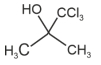
Reaction of iso-propylbenzene with $O _2$ followed by the treatment with $H _3 O ^{+}$forms phenol and a by-product $P$. Reaction of $P$ with $3$ equivalents of $Cl _2$ gives compound $Q$. Treatment of $Q$ with $Ca ( OH )_2$ produces compound $R$ and calcium salt $S$.

The correct statement($s$) regarding $P , Q , R$ and $S$ is(are)

$(A)$ Reaction of $P$ with $R$ in the presence of $KOH$ followed by acidification gives

$(B)$ Reaction of $R$ with $O _2$ in the presence of light gives phosgene gas

$(C)$ $Q$ reacts with aqueous $NaOH$ to produce $Cl _3 CCH _2 OH$ and $Cl _3 CCOONa$

$(D)$ $S$ on heating gives $P$

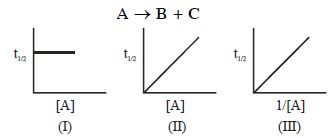
Consider the plots, given below, for the type of reaction

The plots respectively corresponds to the reaction order

To purify fluorine gas, fumes of $HF$ are removed by
At a given temperature, the vapour pressure of a solution of two volatile liquids $A$ and $B$ is given by the equation $P_S = 120 -80\,\,X_B (X_B =$ mole fraction of $B)$ Vapour  pressure of pure $A$ and $B$ at the same temperature are respectively :-
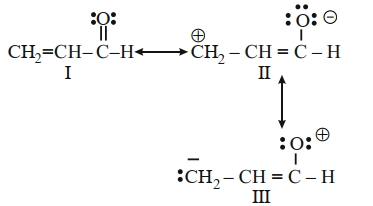
The order of relative stability of the contributing structure is: $IMAGE$  Choose the correct answer from the options given below:
The correct order of increasing ionic radii is .... .