Question
Following questions are based on the two tables given below. Study these tables related to blood sugar levels:
Table A (Blood glucose chart)
Mean Blood Glucose Level (mg/dL)
Doctor's advice needed380
350
315
280
250
215
Good180
150
Excellent115
80
50
Table B (Blood Report of Patient X and Y)
Time of checkBlood Glucose ranges (mg/dL)
Patient XPatient Y
Before breakfast (Fasting)<10070 – 130
Before lunch, supper and snack<11070 - 130
Two hours after meals<140<180
Bedtime<12090 - 15
(a). Refer to Table B showing the blood report of the levels of glucose of patients X and Y. Infer the disease
which can be diagnosed from the given data.
(b). Identify the hormone whose level in the blood is responsible for the above disease.
(c). High/low sugar and a low/high-fat diet What would you recommend to the affected patient?

OR

Refer to Table A and suggest the value of the mean blood glucose level beyond which doctor’s advice is necessary.
Answer

Following questions are based on the two tables given below. Study these tables related to blood sugar levels:
Table A (Blood glucose chart)
Mean Blood Glucose Level (mg/dL)
Doctor's advice needed380
350
315
280
250
215
Good180
150
Excellent115
80
50
Table B (Blood Report of Patient X and Y)
Time of checkBlood Glucose ranges (mg/dL)
Patient XPatient Y
Before breakfast (Fasting)<10070 – 130
Before lunch, supper and snack<11070 - 130
Two hours after meals<140<180
Bedtime<12090 - 15

(i) Diabetes, Diabetes is caused due to less or no secretion of hormone insulin by pancreas.
(ii) Insulin level in the blood is responsible for the given disease.
(iii) Low sugar high fibre diet

OR

> 180mg/dL.

Need a full question paper?

Generate a complete, print-ready paper with questions like this in minutes — across 16+ boards, with answer keys.

Start Generating Free

Similar questions

Blood transports oxygen and carbon dioxide to different parts of the human body.
The exchange of gases between blood and inhaled air takes place in the capillaries of lungs.
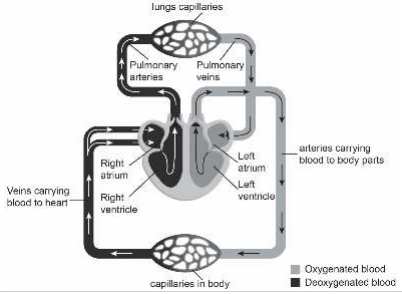
The diagram below shows how blood circulates in the human body.

Image
6. What statement is supported by the diagram?
A. All arteries carry oxygenated blood.
B. Capillaries are permeable to gases.
C. The wall between the left ventricle and the right ventricle is porous.
D. Blood can low back and forth between the right atrium and the right ventricle.
7. Which of these will be the immediate effect if gaseous exchange in the lung capillaries reduces?
A. Blood will low in the reverse direction.
B. Pulmonary veins will receive blood with less oxygen.
C. The space inside the left and the right atrium will increase.
D. The pressure of blood inside the capillaries will decrease.

Alisha digs a pit in her garden and puts the following items in it.
● paper cups
● glass bowls
● fruit peels
● rubber slippers
She then covers the pit with soil.
8. Which item will decompose first?
Refer to the given table regarding results of $\mathrm{F}_{2}$ generation of Mendelian cross.
Plants with round and yellow coloured seeds (P)315
Plants with round and green coloured seeds (Q)108
Plants with wrinkled and yellow coloured seeds (R)101
Plants with wrinkled and green coloured seeds (S)32

i. What would be the phenotype of $F_{1}$ generation regarding given data of $F_{2}$ generation?
ii. What would be the genotype of parental generation regarding the given result of $\mathrm{F}_{2}$ generation?
iii. If a plant with wrinkled and green coloured seeds $(\mathrm{S})$ is crossed with the plant having wrinkled and yellow coloured seeds (R), what will be the probable phenotype of offspring?
OR
What will result when plant YyRr is self-pollinated?
A near sighted person wears eye glass with power of $-5.0$ D for distant vision. Soon, he started having difficulties in viewing nearby objects also. His doctor prescribes a correction of $+1.5 D$ in near vision section of his bi-focal, which is measured relative to main part of the lens.

(i) Find the focal length of his distant viewing part of lens.
(ii) Find the focal length of near vision section of the lens.
(iii) What type of lens is to be used in this spectacles for near vision?
or
(iv) What is the reason of hypermetropia?


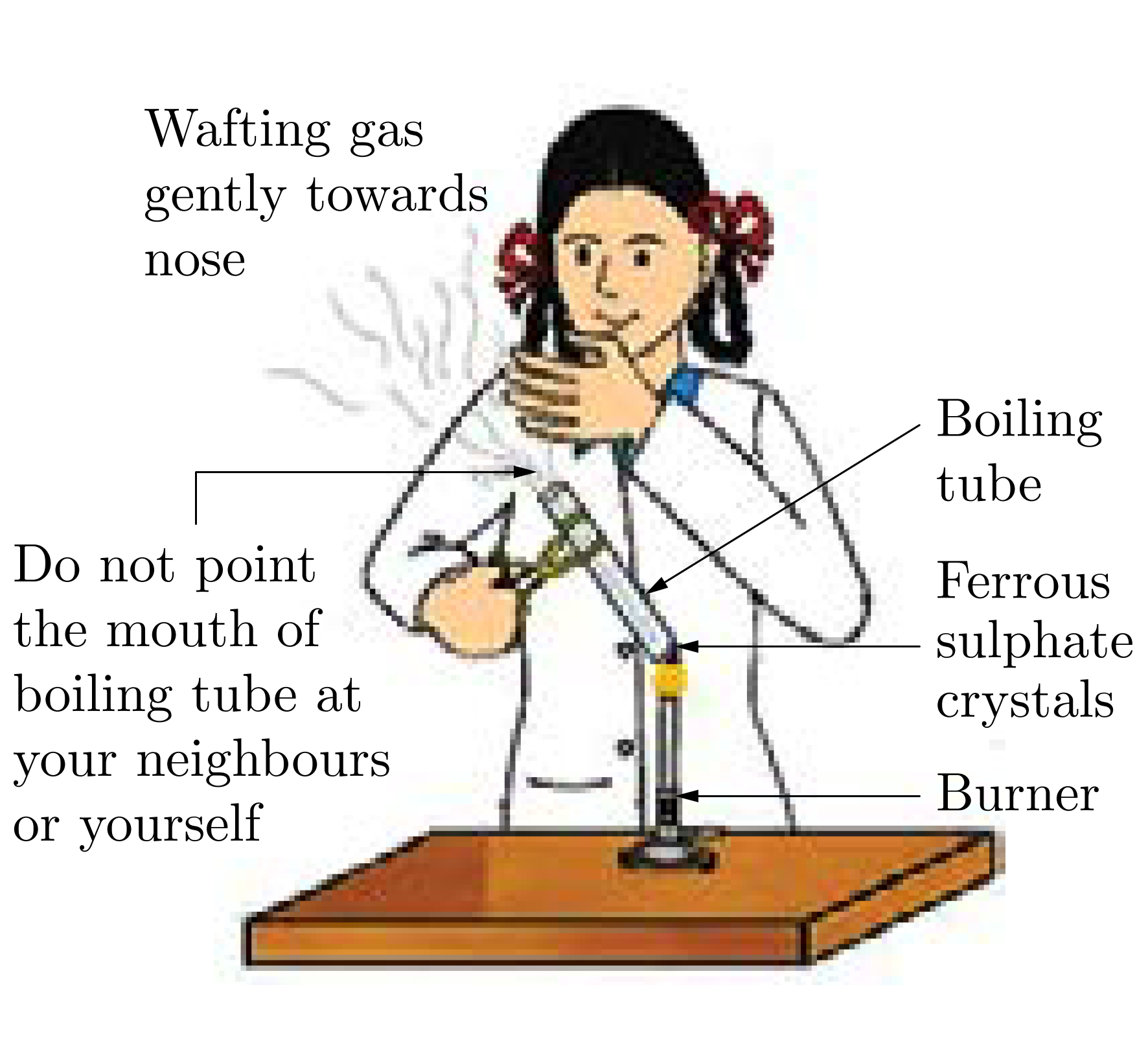
After seeing the above image answer the following questions.
  1. What was the colour of the crystals before heating and after heating?
  2. Write the chemical equation for the reaction.
  3. Which pungent smelling gas is evolved during the reaction? What is the nature of this gas?
    or
    Write the name of the solid substance formed.
Read the following and answer any four questions from (i) to (v).ln decomposition reactions, a single reactant breaks down to form two or more products. Decomposition reaction is opposite to combination reaction. Thermal decomposition reactions use the energy in form of heat for decomposition of reactants. Electrolytic decomposition reactions involve the use of electrical energy for the decomposition of reactant molecules. Photolysis or photochemical decomposition involves the use of light energy for the purpose of decomposition.
  1. Which reactions are a decomposition reaction?
     
  2. Amino acid is fanned by the decomposition of which component of our diet?
     
  3. Silver chloride on exposure to sunlight for a long duration turns gray due to which formation?

    OR

    A) What type of chemical reaction takes place when electricity is passed through water?
    B) Which involves the use of light energy for the purpose of decomposition?

 
Read the following and answer any three questions from (i) to (iv).The rate of flow of charge is called electric current. The SJ unit of electric current is Ampere (A). The direction of flow of current is always opposite to the direction of flow of electrons in the current. The electric potential is defined as the amount of work done in bringing a unit positive test charge from infinity to a point in the electric field. The amount of work done in bringing a unit positive test charge from one point to another point in an electric field is defined as potential difference.
$\text{V}_{\text{AB}}=\text{V}_{\text{B}}-\text{V}_\text{A}=\frac{\text{W}_{\text{BA}}}{\text{q}}$
The SJ unit of potential and potential difference is volt.
  1. The 2C of charge is flowing through a conductor in 100ms, the current in the circuit will?
     
  2. Define electric current? what is the SJ unit of electric current.
     
  3. The potential difference between the two terminals of battery, if 100 joules of work is required to transfer 20 coulombs of charge from one terminal of the battery to other will?
OR
  1. a) Then number of electrons flowing per second in a conductor if I A current is passing through it?
    b) The voltage can be written as.
The lens of the eye does little of the bending of the light rays. Most of the refraction is done at the front surface of the cornea which also acts as a protective covering. The lens acts as a fine adjustment for focussing at different distances. This is accomplished by the ciliary muscle, which change the curvature of the lens so that its focal length is changed. To focus on a distant object, the muscles are relaxed and the lens is thin and parallel rays focus at the focal point (on the retina). To focus on a nearby object, the muscles contract, causing the centre of the lens to be thicker, thus shortening the focal length so that images of nearby objects can be focused on the retina, behind the focal point. This focusing adjustment is called accommodation.
The closest distance at which the eye can focus clearly is called the near point of the eye. A given person's far point is the farthest distance at which an object can be seen clearly. To check your own near point, place this book close to your eye and slowly move it away until the type is sharp.
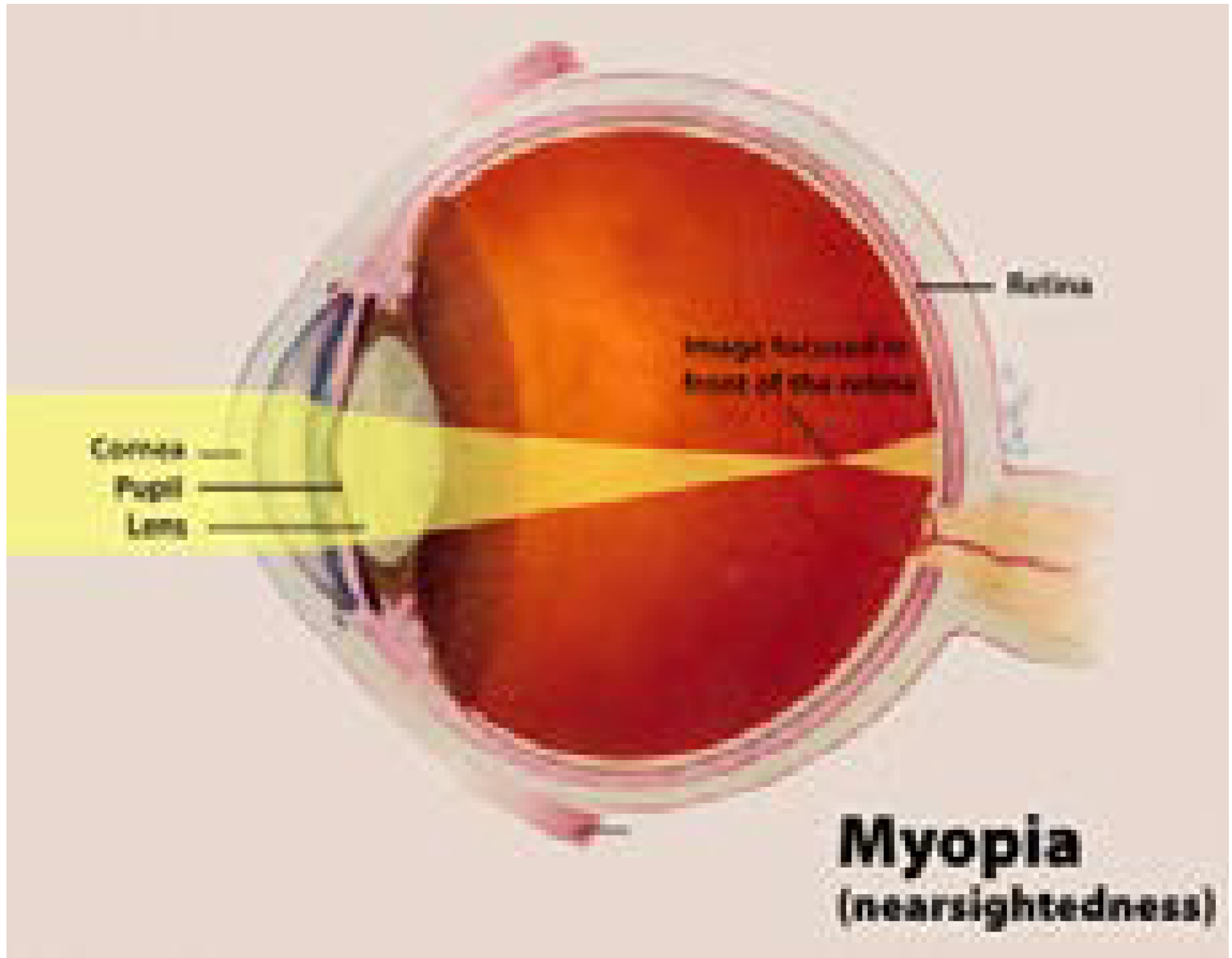
A large part of the population have eyes that do not accommodate within the normal range of $25 cm$ to infinity, or have some other defect. Two common defects are near-sightedness and far-sightedness. Both can be corrected to a large extent with lenses-either eyeglasses or contact lenses.
(i) The ciliary muscle muscles of a normal eye are in their (i). most relaxed (ii). most contracted state. In which of the two cases is the focal length of the eye-lens more?
(ii) What is the least distinct of vision of young man?
(iii) What is persistence of vision?
or
(iv) What is meant by power of accommodation of the eye?
Baking soda is used in small amounts for making bread and cakes. It helps to make these soft and spongy. An aqueous solution of baking soda turns red litmus blue. It is also used in soda acid fire extinguisher. Use this information to answer the following questions.
(i) Write the equation for the reaction between baking soda and acid.
(ii) How does it help in extinguishing fire?
(iii) What is the reaction involved when it is heated?
or
(iv) Is the $pH$ value of baking soda solution lower than or higher than 7 ?