MCQ
For a binary ideal liquid solution, the total pressure of the solution is given as
  • A
    $P_{total} = P_A^o + (P_A^o - P_B^o )X_B$
  • B
    $P_{total} = P_B^o + (P_A^o - P_B^o )X_A$
  • $P_{total} = P_B^o + (P_B^o - P_A^o )X_A$
  • D
    $P_{total} = P_B^o + (P_B^o - P_A^o )X_B$
Answer

Correct option: C.
$P_{total} = P_B^o + (P_B^o - P_A^o )X_A$
c
According to Dalton's law of partial pressure

$p _{ i }= x _{ i } \times P _{ T }$

$P _{ i }=$ partial pressure of the $i ^{\text {th }}$ component

$x _{ i }=$ mole fraction of the $i ^{\text {th }}$ component

$p _{ T }=$ total pressure of mixture

$\Rightarrow 2 atm =\left(\frac{ n _{ H _{2}}}{ n _{ H _{2}}+ n _{ H _{ e }}+ n _{ O _{2}}}\right) \times p _{ T }$

$\Rightarrow p _{ T }=2 atm \times \frac{3}{1}=6 atm$

Need a full question paper?

Generate a complete, print-ready paper with questions like this in minutes — across 16+ boards, with answer keys.

Start Generating Free

Similar questions

A first order reaction is $75\%$ completed in $100\, minutes$. How long will it take for its $87.5\%$ completion .........  $\min$
Which of the following alkali metal ions has lowest ionic mobility in aqueous solutions
The cell potential for the following cell

$Pt \left| H _{2}( g )\right| H ^{+}( aq ) \| Cu ^{2+}(0.01 M ) \mid Cu ( s )$

is $0.576 \,V$ at $298\, K$. The $pH$ of the solution is $......\,.$ (Nearest integer)

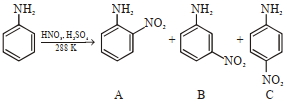
Compound $'P'$ on nitration with dil. $HNO _{3}$ yields two isomers $(A)$ and $(B).$ These isomers can be separated by steam distillation. Isomers $(A)$ and $(B)$ show the intramolecular and intermolecular hydrogen bonding respectively. Compound $(P)$ on reaction with conc. $HNO _{3}$ yields a yellow compound $'C',$ a strong acid. The number of oxygen atoms is present in compound ${ }^{\prime} C'\,....$
Consider the given reaction, percentage yield of :
Decreasing the concentration of an electrophile in a typical $S_N\,^2$ reaction by a factor of $3$ will cause the reaction ratio to
The reaction $A\xrightarrow{k}$ Producl, is zero order while the reaction $B\xrightarrow{k}$ Product, is first order reaction. For what initial concentration of $A$ are the half lives of two reactions equal ?
Phenol reacts with $CHC{l_3}$ and $NaOH$ (at $340K$) to give
$ \mathrm{Ag}^{+}+\mathrm{NH}_3 \rightleftharpoons\left[\mathrm{Ag}\left(\mathrm{NH}_3\right)^{+}\right] ; \mathrm{k}_1=3.5 \times 10^{-3} $

$ {\left[\mathrm{Ag}\left(\mathrm{NH}_3\right)\right]^{+}+\mathrm{NH}_3 \rightleftharpoons\left[\mathrm{Ag}\left(\mathrm{NH}_3\right)_2\right]^{+} ; \mathrm{k}_2=1.7 \times 10^{-3}}$

then the formation constant of $\left[\mathrm{Ag}\left(\mathrm{NH}_3\right)_2\right]^{+}$is

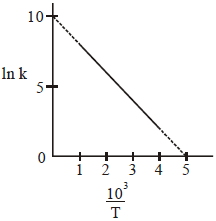
The rate constant $(k)$ of a reaction is measured at different temperatures $(T),$ and the data are plotted in the given figure. The activation energy of the reaction in $kJ\, mol ^{-1}$ is :

($R$ is gas constant)