Question
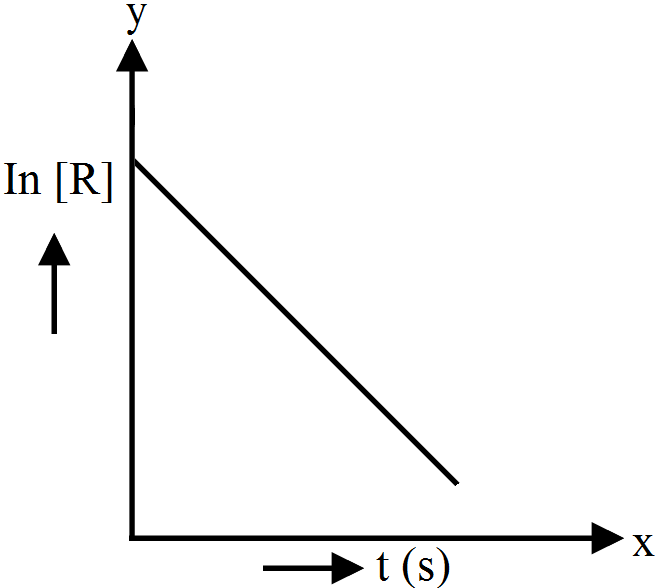
For a certain chemical reaction variation in the concentration ln [R] vs. time plot is given alongside.

For this reaction:

  1. What is the order of the reaction?
  2. What are the units of rate constant k?
  3. Give the relationship between k and t1/2 (half-life period).
  4. What is the slope of the curve?
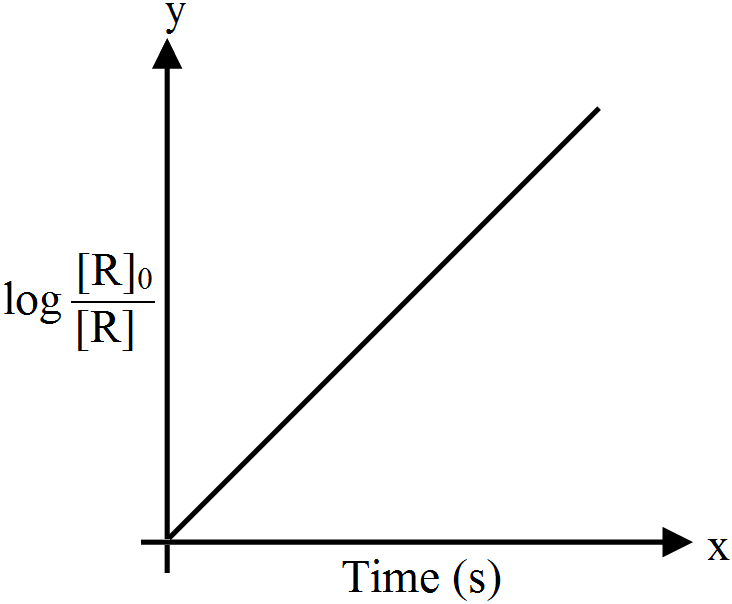
  5. Draw the plot log [R]0 /[R] vs time t(s).
Answer

  1. First order.
  2. Time-1 (s-1)
  3. $\text{k}=\frac{0.693}{\text{t}_{1/2}}$
  4. Slope = - k (rate constant).
  5.  

Need a full question paper?

Generate a complete, print-ready paper with questions like this in minutes — across 16+ boards, with answer keys.

Start Generating Free

Similar questions

Draw the structures of optical isomers of:
i. $\left[ Cr \left( C _2 O _4\right)_3\right]^{3-}$
ii. $\left[ PtCl _2( en )_2\right]^{2+}$
iii. $\left[ Cr \left( NH _3\right)_2 Cl _2( en )\right]^{+}$
The air is a mixture of a number of gases. The major components are oxygen and nitrogen with approximate proportion of 20% is to 79% by volume at 298 K. The water is in equilibrium with air at a pressure of 10 atm. At 298 K if the Henry’s law constants for oxygen and nitrogen at 298 K are 3.30 × 107 mm and 6.51 × 107 mm respectively, calculate the composition of these gases in water.
Explain the mechanism of rusting of iron.
Why the reactivity of chlorobenzene towards nucleophilic substitution increase when electron withdrawing group ( $- NO _2$ ) is attached to the ortho and para positions? Explain.
  1. Complete the following chemical equations:
  1. $\text{Cr}_{2}\text{O}_{7}^{2-}\text{(aq)}+\text{H}_{2}\text{S}\text{(g)}+\text{H}^{+}\text{(aq)}\rightarrow$
  2. $\text{Cu}^{2+}\text{(aq)}+\text{I}^{-}\text{(aq)}\rightarrow$
  1. How would you account for the following:
  1. The oxidising power of oxoanions are in the order VO+2 < Cr2O2–7 <MnO4.
  2. The third ionisation enthalpy of manganese (Z = 25) is exceptionally high.
  3. Cr2+ is a stronger reducing agent than Fe2+.
Write the chemical reactions of $C _2 H _5 OH$ with following compounds :
(i) $CH _2 N_2$ (diazomethane) (ii) ketone, (iii) $HC \equiv$ $C H$ (iv) $C H _3 N C O$ (Methyl-isocyanate) (v) $C H _3 C H O$ (ethanol) (vi) conc. $H _2 SO _4$ at $0^{\circ} C$.
Explain the terms primary and secondary structure of proteins. What is the difference between α-helix and β-pleated sheet structure of proteins?
A steady current of 2 amperes was passed through two electrolytic cells X and Y connected in series containing electrolytes $FeSO_{4}$ and $ZnSO_{4}$ until 2.8 g of Fe deposited at the cathode of cell X. How long did the current flow? Calculate the mass of Zn deposited at the cathode of cell Y. (Molar mass: $Fe = 56 g mol^{-1}, Zn = 65.3 g mol^{-1}, 1 F = 96500 C mol^{-1}$)
(a). While giving intravenous injections to the patients, the doctors take utmost care of the concentration of the solution used. Why is it necessary to check the concentration of the solution?
(b). A solution of phenol was obtained by dissolving 2X 10⁻² kg of phenol in 1 kg of benzene. Experimentally it was found to be 73% associated. Calculate the depression in the freezing point recorded.
Describe the dispersion methods for preparation of colloidal solution.