MCQ
For a given surface the Gauss's law is stated as $\oint E . ds =0$. From this we can conclude that         
  • A
    $E$ is necessarily zero on the surface
  • B
    $E$ is perpendicular to the surface at every point
  • The total flux through the surface is zero
  • D
    The flux is only going out of the surface
Answer

Correct option: C.
The total flux through the surface is zero

Need a full question paper?

Generate a complete, print-ready paper with questions like this in minutes — across 16+ boards, with answer keys.

Start Generating Free

Similar questions

If for a thermocouple $\mathrm{T}_{\mathrm{n}}$ is the neutral temperature, $\mathrm{T}_{\mathrm{c}}$ is the temperature of the cold junction and $\mathrm{T}_{\mathrm{i}}$ is the temperature of inversion, then
The resonant frequency of an L - C circuit is.
The current gain of a transistor in common base mode is 0.995. The current gain of the same transistor in common emitter mode is?
A point source of light is placed at a distance, of 2f from a converging lens of focal length f. The intensity on the other side of the lens is maximum at a distance:
  1. f
  2. between f and 2
  3. 2f
  4. more than 2f.
A radio transmitter operates at a frequency of $880\ kHz$ and a power of $10\ kW.$ The number of photons emitted per second are
The production of e.m.f. by maintaining a difference of temperature between the two junctions of two different metals is known as(a) Joule effect(b) Seebeck effect(c) Peltier effect(d) Thomson effect
       
The wave theory of light does not explain:
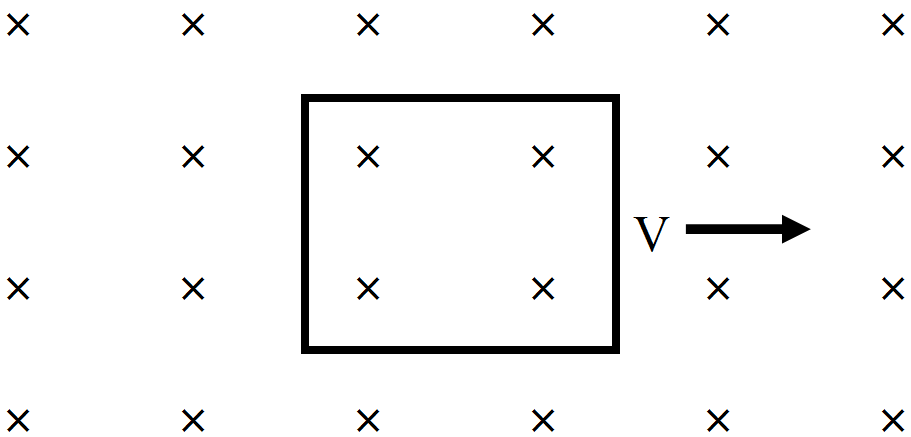
A conducting square loop of side l and resistance R moves in its plane with a uniform velocity u perpendicular to one of its sides. A uniform and constant magnetic field B exists along the perpendicular to the plane of the loop as shown in figure. The current induced in the loop is:
In an electron gun, the electrons are accelerated by the potential $V .$ If $e$ is the charge and $m$ is the mass of an electron, then the maximum velocity of these electrons will be
If a charged particle moves unaccelerated in a region containing electric and magnetic fields,
  1. $\overrightarrow{\text{E}}$ must be perpendicular to $\overrightarrow{\text{B}}$
  2. $\overrightarrow{\text{V}}$ must be perpendicular to $\overrightarrow{\text{E}}$
  3. $\overrightarrow{\text{V}}$ must be perpendicular to $\overrightarrow{\text{B}}$
  4. E must be equal to vB.