Question
For a normal distribution, the third quartile and quartile deviations are $36$ and $24$ respectively. Find the mean of the distribution.
Answer

Here, $\mathrm{Q}_3=36$ and mean deviation $=24$.
Now, mean deviation $=\frac{4}{5} \sigma$
$\therefore 24=\frac{4}{5} \sigma$
$ \therefore 24 \times \frac{5}{4}=\sigma$
$ \therefore \sigma=30$
$ Q_3=36$
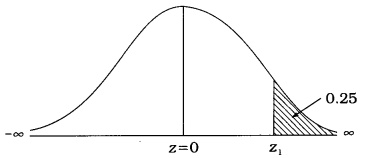
$\therefore 25 \%$ of the observations of the distributions are more than $36 .$
For $x=36, z_1=\frac{36-\mu}{\sigma}=\frac{36-\mu}{30}$
Now, $P[X \geq 36]=0.25$
$\therefore P\left[Z \geq Z_1\right]=0.25$
Image
$\therefore P\left[0 \leq Z \leq z_1\right]=0.50-0.25=0.25$
From the table, for area $0.2486, z_1=0.67$ and for area $0.2518, z_1=0.68$
$\therefore$ For area $0.25 ,$
$z_1=\frac{0.67+0.68}{2}=0.675$
Now, $z_1=\frac{36-\mu}{30}$
$\therefore 0.675=\frac{36-\mu}{30}$
$ \therefore 0.675 \times 30=36-\mu$
$ \therefore 20.25=36-\mu$
$ \therefore \mu=36-20.25$
$ \therefore \mu=15.75$
Hence, the mean of the distribution obtained is $15.75 .$

Need a full question paper?

Generate a complete, print-ready paper with questions like this in minutes — across 16+ boards, with answer keys.

Start Generating Free