MCQ
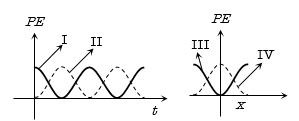
For a particle executing $S.H.M.$ the displacement $x$ is given by $x = A\cos \omega t$. Identify the graph which represents the variation of potential energy $(P.E.)$ as a function of time $t$ and displacement $x$
  • $I, III$
  • B
    $II, IV$
  • C
    $II, III$
  • D
    $I, IV$

Answer

Correct option: A.
$I, III$
a
(a) Potential energy is minimum (in this case zero) at mean position ($x = 0$) and maximum at extreme position $(x = \pm A).$
At time $t = 0, x = A,$ hence potential should be maximum.

Therefore graph $I$ is correct. Further in graph $III.$ Potential energy is minimum at $x = 0,$ hence this is also correct.

Need a full question paper?

Generate a complete, print-ready paper with questions like this in minutes — across 16+ boards, with answer keys.

Start Generating Free

Similar questions

In photoelectric effect if the intensity of light is doubled then maximum kinetic energy of photoelectrons will become
A solid sphere of mass $1\,kg$ rolls without slipping on a plane surface. Its kinetic energy is $7 \times 10^{-3}\,J$. The speed of the centre of mass of the sphere is $.........cm s ^{-1}$.
Initial angular velocity of a circular disc of mass $M$ is $\omega_{1}$. Then two small spheres of mass $m$ are attached gently to two diametrically opposite points on the edge of the disc. What is the final angular velocity of the disc?
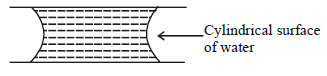
If two glass plates have water between them and are separated by very small distance ( see figure), it is very difficult to pull them apart. It is because the water in between forms cylindrical surface on the side that gives rise to lower pressure in the water in comparison to atmosphere. If the radius of the cylindrical surface is $R$ and surface tension of water is $T$ then the pressure in water between the plates is lower by
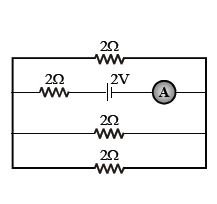
The reading of the ammeter as shown in figure
Coefficient of linear expansion of brass and steel rods are $\alpha_1$ and $\alpha_2$. Lengths of brass and steel rods are $l_1$ and $l_2$ respectively. If $\left(l_2-l_1\right)$ is maintained same at all temperatures, which one of the following relations holds good?
If transmission power of a surface is $\frac{1}{9}$, reflective power is $\frac{1}{6}$, then what is its absorptive power?
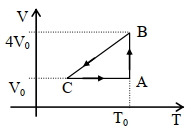
One mole of an ideal gas in initial state $\mathrm{A}$ undergoes a cyclic process $A B C A$, as shown in the figure. Its pressure at $A$ is $\mathrm{P}_0$. Choose the correct option$(s)$ from the following

$(A)$ Internal energies at $\mathrm{A}$ and $\mathrm{B}$ are the same

$(B)$ Work done by the gas in process $\mathrm{AB}$ is $\mathrm{P}_0 \mathrm{~V}_0 \ln 4$

$(C)$ Pressure at $C$ is $\frac{P_0}{4}$

$(D)$ Temperature at $\mathrm{C}$ is $\frac{\mathrm{T}_0}{4}$

The component of vector $A = 2\hat i + 3\hat j$ along the vector $\hat i + \hat j$is
body moves with constant angular velocity on a circle. Magnitude of angular acceleration