Question
For a particle executing simple harmonic motion, the acceleration is proportional to:
  1. Displacement from the mean position.
  2. Distance from the mean position.
  3. Distance travelled since t = 0.
  4. Speed.

Answer

  1. Displacement from the mean position.

Explanation:

For S.H.M.,

F = -kx

ma = -kx (F = ma)

or,

$\text{a}=-\frac{\text{k}}{\text{m}}\text{x}$

Thus, acceleration is proportional to the displacement from the mean position but in opposite direction.

Need a full question paper?

Generate a complete, print-ready paper with questions like this in minutes — across 16+ boards, with answer keys.

Start Generating Free

Similar questions

‘Gulab Jamuns’ (assumed to be spherical) are to be heated in an oven. They are available in two sizes, one twice bigger (in radius) than the other. Pizzas (assumed to be discs) are also to be heated in oven. They are also in two sizes, one twice big (in radius) than the other. All four are put together to be heated to oven temperature. Choose the correct option from the following:
A gas mixture consists of $2$ moles of oxygen and 4 moles of neon at temperature $T$. Neglecting all vibrational modes, the total internal energy of the system will be $...........\,RT$ 
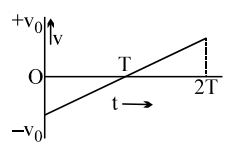
The figure shows the velocity $(v)$ of a particle plotted against time $(t)$
If the temperature of the body is increased by $10\% $ , the percentage increase in the emitted radiation will be ....... $\%$
A particle performs $SHM$ on $x-$ axis with time period of $0.5\,sec,$ such that it's velocity is zero at $x = -3\,cm$ and at $x = 9\,cm$. It was located at $x = 0$ and moving in negative $'x'$ at $t = 0$. The equation of $SHM$ of the particle is
Which of the following laws cannot be find on the basis of molecular kinetic theory?
A photon of energy hv is absorbed by o free electron of a metal having work function $\varphi<\text{hv}.$
  1. The electron is sure to come out.
  2. The electron is sure to come out with a kinetic energy $\text{hv}-\varphi.$
  3. Either the electron does not come out or it comes out with a kinetic energy $\text{hv}-\varphi$ .
  4. It may come out with a kinetic energy less than $\text{hv}-\varphi.$
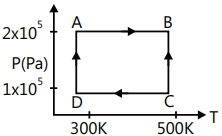
Two moles of helium gas are taken over the cycle $ABCDA$, as shown in the $P-T$ diagram. The net work done on the gas in the cycle $ABCDA$ is ...... $R$
Five particles of mass = $2\ kg$ are attached to the rim of a circular disc of radius $0.1\ m$ and negligible mass. Moment of inertia of the system about the axis passing through the centre of the disc and perpendicular to its plane is ........ $kg\,m^2$
$A$ boy hits $a$ baseball with $a$ bat and imparts an impulse $J$ to the ball. The boy hits the ball again with the same force, except that the ball and the bat are in contact for twice the amount of time as in the first hit. The new impulse equals: