MCQ
For a particle in a non-uniform accelerated circular motion
  • A
    Velocity is radial and acceleration is transverse only
  • B
    Velocity is transverse and acceleration is radial only
  • C
    Velocity is radial and acceleration has both radial and transverse components
  • Velocity is transverse and acceleration has both radial and transverse components
Answer

Correct option: D.
Velocity is transverse and acceleration has both radial and transverse components
d
(d)In non-uniform circular motion particle possess both centripetal as well as tangential acceleration.

Need a full question paper?

Generate a complete, print-ready paper with questions like this in minutes — across 16+ boards, with answer keys.

Start Generating Free

Similar questions

Which of the following represents a $volt$
A bullet of mass $4\,g$ is fired horizontally with a speed of $300\,m/s$ into $0.8\,kg$ block of wood at rest on a table. If the coefficient of friction between the block and the table is $0.3,$ how far will the block slide approximately?
Under constant temperature, graph between $P$ and $1/V$ is
A body of mass 10kg is acted upon by two perpendicular forces, 6N and 8N. The resultant acceleration of the body is:
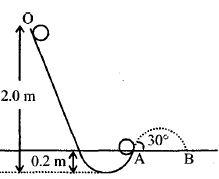
A tennis ball (treated as hollow spherical shell) starting from $O$ rolls down a hill. At point $A$ the ball becomes air borne leaving at an angle of $30^o$ with the horizontal. The ball strikes the ground at $B$. What is the value of the distance $AB$ ? (Moment of inertia of a spherical shell of mass $m$ and radius $R$ about its diameter .......... $m$. $= \frac {2}{3}\,mR^2$)
One main scale division of a vernier caliper is equal to $m$ units. If $n^{\text {th }}$ division of main scale coincides with $(n+1)^{\mathrm{ht}}$ division of vernier scale, the least count of the vernier caliper is:
A cylinder of $10 \,kg$ is sliding in a plane with an initial velocity of $10 \,m/s$. If the coefficient of friction between the surface and cylinder is $0.5$ then before stopping, it will cover. $(g = 10\,\,m/{s^2})$ ........ $m$
A stick has its bottom end attached to a wall by a pivot and is held up by a massless string attached to its other end. Which of the following scenarios has the smallest tension in the string ? (Length of stick is same in all scenarios)
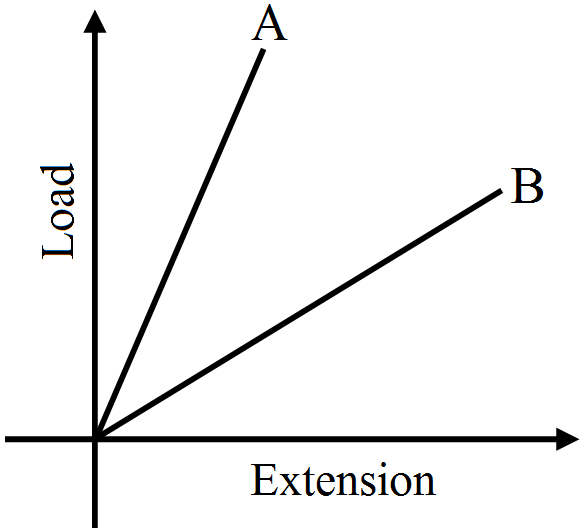
In the given figure, if the dimension of the wire are the same and materials are different, Young's modulus is more for:

A simple pendulum of frequency $f$ has a metal bob. If bob is charged negatively and is allowed to oscillate with large positive charged plate under it, frequency will be