MCQ
For a particle in a uniformly accelerated circular motion
  • A
    velocity is radial and acceleration has both radial and transverse components
  • velocity is transverse and acceleration has both radial and transverse components
  • C
    velocity is radial and acceleration is transverse only
  • D
    velocity is transverse and acceleration is radial only
Answer

Correct option: B.
velocity is transverse and acceleration has both radial and transverse components
b
For a uniformly accelerated motion there are two acceleration, one along the radius called radial acceleration and another along tangent called tangential acceleration. Velocity is directed along the tangent

Need a full question paper?

Generate a complete, print-ready paper with questions like this in minutes — across 16+ boards, with answer keys.

Start Generating Free

Similar questions

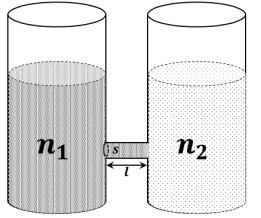
As shown schematically in the figure, two vessels contain water solutions (at temperature $T$ ) of potassium permanganate $\left( KMnO _4\right)$ of different concentrations $n_1$ and $n_2\left(n_1>n_2\right)$ molecules per unit volume with $\Delta n=\left(n_1-n_2\right) \ll n_1$. When they are connected by a tube of small length $\ell$ and cross-sectional area $S , KMnO _4$ starts to diffuse from the left to the right vessel through the tube. Consider the collection of molecules to behave as dilute ideal gases and the difference in their partial pressure in the two vessels causing the diffusion. The speed $v$ of the molecules is limited by the viscous force $-\beta v$ on each molecule, where $\beta$ is a constant. Neglecting all terms of the order $(\Delta n)^2$, which of the following is/are correct? ( $k_B$ is the Boltzmann constant)-

$(A)$ the force causing the molecules to move across the tube is $\Delta n k_B T S$

$(B)$ force balance implies $n_1 \beta v \ell=\Delta n k_B T$

$(C)$ total number of molecules going across the tube per sec is $\left(\frac{\Delta n}{\ell}\right)\left(\frac{k_B T}{\beta}\right) S$

$(D)$ rate of molecules getting transferred through the tube does not change with time

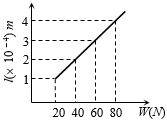
The adjacent graph shows the extension $(\Delta l)$ of a wire of length $1m$ suspended from the top of a roof at one end with a load $W$ connected to the other end. If the cross sectional area of the wire is ${10^{ - 6}}{m^2},$ calculate the young’s modulus of the material of the wire
The gas which satisfies the equation PV = nRTat all pressure and temperature is called as:
The equation of motion of a projectile are given by $ x = 36 t\,metre$ and $2y = 96 t -9.8 t^2\, metre$. The angle of projection is
Liquid cools from $50^oC$  to  $45^oC$  in  $5\  minutes$ and from $45^oC$ to $41.5^oC$ in the next $5\   minutes$.The temperature of the surrounding is ......... $^oC$
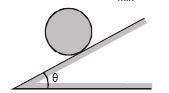
A hollow sphere of mass $m$ filled with a non-viscous liquid of same mass $m$ is released on a slope inclined at angle $q$ with the horizontal. The friction between the sphere and the slope is sufficient to prevent sliding and frictional forces between the inner surface of the sphere and the liquid is negligible. After descending a certain height ratio of translational and rotational kinetic energies is found to be $x:y$, find the numerical value of expression $(x+y)_{min}.$
A force $F = (5\hat i + 3\hat j)$ newton is applied over a particle which displaces it from its origin to the point $r = (2\hat i - 1\hat j)$ metres. The work done on the particle is....$joules$
A vessel of volume $8\, litre$ contains an ideal gas at $300\, K$ and $2\, atm$ pressure. The gas is allowed to leak till pressure become $125\, kpa$ calculate amount of moles which leak out if temperature remain constant ...... $moles$
If $L$ denotes the inductance of an inductor through which a current $i$ is flowing, the dimensions of $L{I^2}$ are
In an experiment with sonometer when a mass of $180\,g$ is attached to the string, it vibrates with fundamental frequency of $30\,Hz$. When a mass $m$ is attached, the string vibrates with fundamental frequency of $50\,Hz$. The value of $m$ is $.........\,g$.