MCQ
For a particle in circular motion the centripetal acceleration is
  • A
    Less than its tangential acceleration
  • B
    Equal to its tangential acceleration
  • C
    More than its tangential acceleration
  • May be more or less than its tangential acceleration

Answer

Correct option: D.
May be more or less than its tangential acceleration
d
(d)There is no relation between centripetal and tangential acceleration. Centripetal acceleration is must for circular motion but tangential acceleration may be zero.

Need a full question paper?

Generate a complete, print-ready paper with questions like this in minutes — across 16+ boards, with answer keys.
Start Generating Free

Similar questions

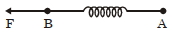
Two masses $A$ and $B ,$ each of mass $M$ are fixed together by a massless spring. $A$ force acts on the mass $B$ as shown in figure. If the mass $A$ starts moving away from mass $B$ with acceleration $'a',$ then the acceleration of mass $B$ wil be :-
Moment of inertia of a dise of mass $M$ and radius ' $R$ ' about any of its diameter is $\frac{ MR ^2}{4}$. The moment of inertia of this disc about an axis normal to the disc and passing through a point on its edge will be, $\frac{ x }{2} MR ^2$. The value of $x$ is $..........$.
A particle is moving in a circular path of radius $r$ under the action of a force $F$. If at an instant velocity of particle is $v$, and speed of particle is increasing, then
A vehicle of mass $m$ is moving on a rough horizontal road with momentum $P$. If the coefficient of friction between the tyres and the road be $\mu$, then the stopping distance is
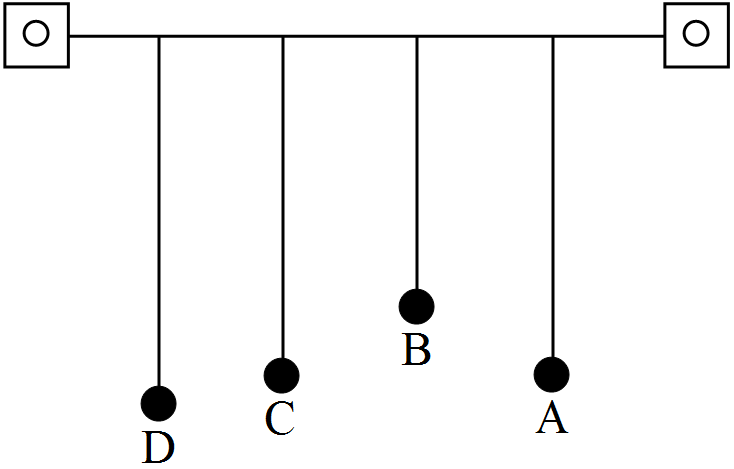
Four pendulums A, B, C and D are suspended from the same elastic support as shown in Fig A and C are of the same length, while B is smaller than A and D is larger than A. If A is given a transverse displacement,

The mean free path of molecules ofa gas, (radius $r$) is inversely proportional to
The position of a particle at time $t$ is given by the relation $x(t) = \left( {\frac{{{v_0}}}{\alpha }} \right)\,\,(1 - {e^{ - \alpha t}})$, where ${v_0}$ is a constant and $\alpha > 0$. The dimensions of ${v_0}$ and $\alpha $ are respectively
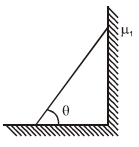
In the figure, a ladder of mass $m$ is shown leaning against a wall. It is in static equilibrium making an angle $\theta$ with the horizontal floor. The coefficient of friction between the wall and the ladder is $\mu_1$ and that between the floor and the ladder is $\mu_2$. The normal reaction of the wall on the ladder is $N_1$ and that of the floor is $N_2$. If the ladder is about to slip, then

$Image$

$(A)$ $\mu_1=0 \mu_2 \neq 0$ and $N _2 \tan \theta=\frac{ mg }{2}$

$(B)$ $\mu_1 \neq 0 \mu_2=0$ and $N_1 \tan \theta=\frac{m g}{2}$

$(C)$ $\mu_1 \neq 0 \mu_2 \neq 0$ and $N _2 \tan \theta=\frac{ mg }{1+\mu_1 \mu_2}$

$(D)$ $\mu_1=0 \mu_2 \neq 0$ and $N _1 \tan \theta=\frac{ mg }{2}$
Dimensions of coefficient of viscosity are
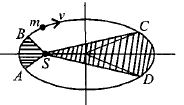
The figure shows elliptical orbit of a planet $m$ about the sun $S.$ The shaded area $SCD$ is twice the shaded area $SAB.$ If $t_1$ is the time for the planet to move from $C$ to $D$ and $t_2$ is the time to move from $A$ to $B$ then