MCQ
For a reversible process, necessary condition is
  • A
    In the whole cycle of the system, the loss of any type of heat energy should be zero
  • B
    That the process should be too fast
  • C
    That the process should be slow so that the working substance should remain in thermal and mechanical equilibrium with the surroundings
  • The loss of energy should be zero and it should be quasistatic
Answer

Correct option: D.
The loss of energy should be zero and it should be quasistatic
d
(d) For a reversible process $\int {\frac{{dQ}}{T} = 0} $

Need a full question paper?

Generate a complete, print-ready paper with questions like this in minutes — across 16+ boards, with answer keys.

Start Generating Free

Similar questions

Alarge tank is filled with water to a height $H$.A small hole is made at the base of the tank. It takes $T_1$ time to decrease the height of water to $H/ \eta , (\eta > 1)$ and it takes $T_2$ time to take out the rest of water. If $T_1 = T_2$ , then the value of $\eta$ is :
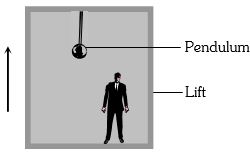
A man measures the period of a simple pendulum inside a stationary lift and finds it to be $T$ sec. If the lift accelerates upwards with an acceleration $\frac{g}{4}$, then the period of the pendulum will be
A closed vessel contains $0.1$ mole of a monoatomic ideal gas at $200\, K$. If $0.05$ mole of the same gas at $400\, K$ is added to it, the final  equilibrium temperature (in $K$ ) of the gas in the vessel will be closed to
A capillary tube of radius $R$ is immersed in water and water rises in it to a height $H$. Mass of water in the capillary tube is $M$. If the radius of the tube is halved, mass of water that will rise in the capillary tube will now be
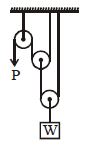
The ideal mechanical advantage of the combination of pulleys shown is
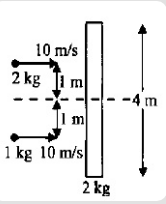
A long slender rod of mass $2\ kg$ and length $4m$ is placed on a smooth horizontal table. Two particles of masses $2\ kg$ and $1\ kg$ strike the rod simultaneously and stick to the rod after collision as shown in Figure. Velocity of the centre of mass of the rod after collision is:
A particle of mass m is under the influence of a force $F$ which varies with the displacement $x$ according to the relation $F = - kx + {F_0}$ in which $k$ and ${F_0}$ are constants. The particle when disturbed will oscillate
An object may have:
  1. Varying speed without having varying velocity.
  2. Varying velocity without having varying speed.
  3. Nonzero acceleration without having varying velocity.
  4. Nonzero acceleration without having varying speed.
A bomber plane moves horizontally with a speed of $500\, m/s$ and a bomb released from it, strikes the ground in $10\, sec$. Angle at which it strikes the ground will be $(g = 10\,\,m/{s^2})$
How many wavelength of $K{r^{86}}$ are there in one metre