MCQ
For a solid with a small expansion coefficient$:$
  • A
    $C_p - C_v = R$
  • $C_p = C_v$
  • C
    $C_p$ is slightly greater than $C_v$
  • D
    $C_p$ is slightly less than $C_v$

Answer

Correct option: B.
$C_p = C_v$
For a solid with a small expansion coefficient, work done in a process will also be small.
Thus, the specific heat depends slightly on the process.
Therefore, $C_p$ is slightly greater than $C_{v.}$

Need a full question paper?

Generate a complete, print-ready paper with questions like this in minutes — across 16+ boards, with answer keys.
Start Generating Free

Similar questions

A closed cubical box is completely filled with water and is accelerated horizontally towards right with an acceleration α. The resultant normal force by the water on the top of the box.
  1. Passes through the centre of the top.
  2. Passes through a point to the right of the centre.
  3. Passes through a point to the left of the centre.
  4. Pecomes zeros.
Capacitiors are used in electrical circuits where appliances need more:
A rectangular coil is rotating with a uniform angular velocity between magnetic poles. The correct graph of change of magnetic flux $\phi$ passing through the coil and induced emf (c) with time is :
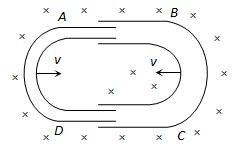
One conducting $U$ tube can slide inside another as shown in figure, maintaining electrical contacts between the tubes. The magnetic field $B$ is perpendicular to the plane of the figure. If each tube moves towards the other at a constant sped $v$ then the emf induced in the circuit in terms of $B, l$ and $v$ where $l$ is the width of each tube, will be
Lenz's law is associated with the principle of conservation of :
Which of the following is not a point of similarity between Biot-Savart law and Coulomb’s law.
The dimensions $\text{ML}^{-1}\text{T}^{-2}$ may correspond to:
  1. Work done by a force.
  2. Linear momentum.
  3. Pressure.
  4. Energy per unit volume.
Assertion : All the radioactive elements are ultimately converted in lead.
Reason     : All the elements above lead are unstable. (a) If both assertion and reason are true and the reason is the correct explanation of the assertion.(b) If both assertion and reason are true but reason is not the correct explanation of the assertion.(c) If assertion is true but reason is false.(d) If the assertion and reason both are false.


The drift velocity does not depend upon(a) Cross-section of the wire(b) Length of the wire(c) Number of free electrons(d) Magnitude of the current
   
   
When objects at different distances are seen by the eye, which of the following remain constant?