MCQ
For a strong electrolyte, a plot of molar conductivity against (concentration) ${ }^{1 / 2}$ is a straight line, with a negative slope, the correct unit for the slope is
  • $\mathrm{S} \mathrm{cm}^2 \mathrm{~mol}^{-3 / 2} \mathrm{~L}^{1 / 2}$
  • B
    $\mathrm{S} \mathrm{cm}^2 \mathrm{~mol}^{-1} \mathrm{~L}^{1 / 2}$
  • C
    $\mathrm{S} \mathrm{cm}^2 \mathrm{~mol}^{-3 / 2} \mathrm{~L}$
  • D
    $\mathrm{S} \mathrm{cm}^2 \mathrm{~mol}^{-3 / 2} \mathrm{~L}^{-1 / 2}$

Answer

Correct option: A.
$\mathrm{S} \mathrm{cm}^2 \mathrm{~mol}^{-3 / 2} \mathrm{~L}^{1 / 2}$
a
$\Lambda_{\mathrm{m}}=\Lambda_{\mathrm{m}}^{\circ}-\mathrm{A} \sqrt{\mathrm{C}}$

Units of $\mathrm{A} \sqrt{\mathrm{C}}=\mathrm{S} \mathrm{cm}^2 \mathrm{~mole}^{-1}$

Uits of $\mathrm{A}=\mathrm{S} \mathrm{cm}^2 \mathrm{~mole}^{-3 / 2} \mathrm{~L}^{1 / 2}$

Need a full question paper?

Generate a complete, print-ready paper with questions like this in minutes — across 16+ boards, with answer keys.

Start Generating Free

Similar questions

Specific reagent required for dehydrohalogenation is :
Identify the correct sequence for True and False

$(I)$ Only compounds with chiral centers can be optically active

$(II)$ Absence of elements of symmetry is the reason for a molecule's optical activity

$(II)$ All organic compounds contain carbon & hydrogen

$(IV)$ Different cannonical forms of a molecule represent the actual structures of a molecule which has resonace in it

Among the given solutions which one has highest boiling point under similar condition?
The pair(s) of coordination complexes/ions exhibiting the same kind of isomerism is(are)

$(A)$ $\left[ Cr \left( NH _3\right)_5 Cl ^2 Cl _2\right.$ and $\left[ Cr \left( NH _3\right)_4 Cl _2\right) Cl$

$(B)$ $\left[ Co \left( NH _3\right)_4 Cl _2\right]^{+}$and $\left[ Pt \left( NH _3\right)_2\left( H _2 O \right) Cl \right]^{+}$

$(C)$ $\left[ CoBr _2 Cl _2\right]^{2-}$ and $\left[ PtBr _2 Cl _2\right]^{2-}$

$(D)$ $\left[ Pt \left( NH _3\right)_3\left( NO _3\right) Cl\right.$ and $\left[ Pt \left( NH _3\right)_3 Cl \right] Br$

Which does not form complex
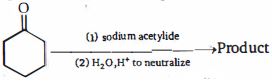
Give the major organic product of the following reaction.
The reaction of $K _3\left[ Fe ( CN )_6\right]$ with freshly prepared $FeSO _4$ solution produces a dark blue precipitate called Turnbull's blue. Reaction of $K _4\left[ Fe ( CN )_6\right]$ with the $FeSO _4$ solution in complete absence of air produces a white precipitate $X$, which turns blue in air. Mixing the $FeSO _4$ solution with $NaNO _3$, followed by a slow addition of concentrated $H _2 SO _4$ through the side of the test tube produces a brown ring.

Precipitate $X$ is

$(A)$ $Fe _4\left[ Fe ( CN )_6\right]_3$

$(B)$ $Fe \left[ Fe ( CN )_6\right]$

$(C)$ $K _2 Fe \left[ Fe ( CN )_6\right]$

$(D)$ $KFe \left[ Fe ( CN )_6\right]$

Among the following, the brown ring is due to the formation of

$(A)$ $\left[ Fe ( NO )_2\left( SO _4\right)_2\right]^{2-}$

$(B)$ $\left[ Fe ( NO )_2\left( H _2 O \right)_4\right]^{3+}$

$(C)$ $\left[ Fe ( NO )_4\left( SO _4\right)_2\right]$

$(D)$ $\left[ Fe ( NO )\left( H _2 O \right)_5\right]^{2+}$
How many of the following reaction will form $PH_3$ gas

$(1) Ca_3P_2 + H_2O \to$

$(2)$ ${H_3}P{O_3}\xrightarrow{\Delta }$

$(3) P_4 + NaOH \to$

$(4)$ ${H_3}P{O_4}\xrightarrow{\Delta }$

$(5) HNO_3 + P_4O_{10} \to$

$(6)$ $P_4+HNO_3 \to$

Which of the following reagents convert propene to $1-$ propanol?
Product $(C)$ of the above reaction is
