MCQ
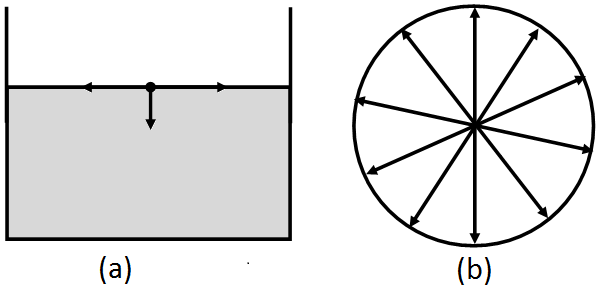
For a surface molecule:
  • A
    The net force on it is zero.
  • B
    There is a net downward force.
  • C
    The potential energy is more than that of a molecule inside.
  • Both $B$ and $D$

Answer

Correct option: D.
Both $B$ and $D$
A molecule viewed from the top to surface of the fluid. Force exerted on a molecule by all nearby molecule are equal and opposite, so net horizontal component of force is zero. as a molecule is viewed horizontally to the surface of fluid a vertically downward force acts on molecule due to which it does not escape from surface.

There is a net attractive force on molecules at surface acting downwards.
So the $P.E$ of molecules at the surface is negative to lower ones but in magnitude $\text{PE(mgh)}$ is more than that of the lower or inside molecules.

Need a full question paper?

Generate a complete, print-ready paper with questions like this in minutes — across 16+ boards, with answer keys.
Start Generating Free

Similar questions

If a tunnel is made along the diameter of the 90 and in that if you leave a stone :
The diatomic molecule is treated as:
The lift of an air plane is based on
A vibratory motion is represented by $x = 2A\,\cos \omega t + A\,\cos \,\left( {\omega t + \frac{\pi }{2}} \right) + A\,\cos \,\left( {\omega t + \pi } \right)$ $ + \frac{A}{2}\,\cos \left( {\omega t + \frac{{3\pi }}{2}} \right)$. The resultant amplitude of the motion is
A ball thrown by one player reaches the other in $2\, sec$. The maximum height attained by the ball above the point of projection will be about .......... $m$
For two different gases $X$ and $Y,$ having degrees of freedom $f_1$ and $f_2$ and molar heat capacities at constant volume $C_{v_1}$ and $C_{v_2}$ respectively, for adiabatic process , the $\ln P$ versus $\ln V$ graph is plotted as shown :-
In a cyclic process, work done by the system is
A particle of mass $\mathrm{m}$ is projected with a speed $u$ from the ground at an angle $\theta=\frac{\pi}{3}$ w.r.t. horizontal ($x-$axis). When it has reached its maximum height, it collides completely inelastically with another particle of the same mass and velocity $u \hat i$. The horizontal distance covered by the combined mass before reaching the ground is
If the ratio of same thickness's wire densities is 1 : 2. If we keep same mass then ratio of same length frequency will be :
A highly rigid cubical block $A$ of small mass $M$ and side $L$ is fixed rigidly onto another cubical block $B$ of the same dimensions and of low modulus of rigidity $\eta $ such that the lower face of $A$ completely covers the upper face of $B$. The lower face of $B$is rigidly held on a horizontal surface. A small force $F$ is applied perpendicular to one of the side faces of $A$. After the force is withdrawn block $A$ executes small oscillations. The time period of which is given by