Question
For a surface molecule:
  1. The net force on it is zero.
  2. There is a net downward force.
  3. The potential energy is less than that of a molecule inside.
  4. The potential energy is more than that of a molecule inside.

Answer

  1. There is a net downward force.
  1. The potential energy is more than that of a molecule inside.

Explanation:

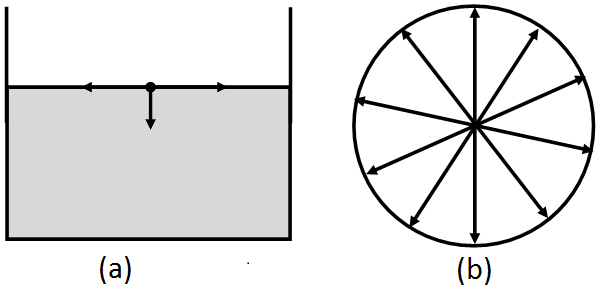
A molecule viewed from the top to surface of the fluid. Force exerted on a molecule by all nearby molecule are equal and opposite, so net horizontal component of force is zero. as a molecule is viewed horizontally to the surface of fluid a vertically downward force acts on molecule due to which it does not escape from surface.

There is a net attractive force on molecules at surface acting downwards. So the P.E of molecules at the surface is negative to lower ones but in magnitude PE(mgh) is more than that of the lower or inside molecules.

Need a full question paper?

Generate a complete, print-ready paper with questions like this in minutes — across 16+ boards, with answer keys.

Start Generating Free

Similar questions

A rubber ball is dropped from a height of $5 \,m$ on a planet where the acceleration due to gravity is not known. On bouncing, it rises to $1.8\, m$. The ball loses its velocity on bouncing by a factor of
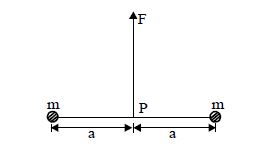
Two particles of mass $m$ each are tied at the ends of a light string of length $2a$ . The whole system is kept on a frictionless horizontal surface with the string held tight so that each mass is at a distance $'a'$ from the centre $P$ (as shown in the figure). Now, the mid-point of the string is pulled vertically upwards with a small but constant force $F$ . As a result, the particles move towards each other on the surface. The magnitude of acceleration, when the separation between them becomes $2x$ , is
A person travels along a straight road for the first half time with a velocity ${v_1}$ and the next half time with a velocity ${v_2}$ . The mean velocity $V$ of the man is
The value of restitution coefficient e for perfectly elastic collision is:
Two bodies A and B having equal surface areas are maintained at temperatures 10°C and 20°C. The thermal radiation emitted in a given time by A and B are in the ratio:
  1. 1 : 1.15
  2. 1 : 2
  3. 1 : 4
  4. 1 : 16
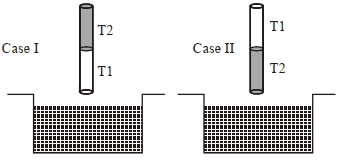
A cylindrical capillary tube of $0.2 mm$ radius is made by joining two capillaries $T 1$ and $T 2$ of different materials having water contact angles of $0^{\circ}$ and $60^{\circ}$, respectively. The capillary tube is dipped vertically in water in two different configurations, case I and II as shown in figure. Which of the following option($s$) is(are) correct?

(Surface tension of water $=0.075 N / m$, density of water $=1000 kg / m ^3$, take $g =10 m / s ^2$ )

$(1)$ The correction in the height of water column raised in the tube, due to weight of water contained in the meniscus, will be different for both cases.

$(2)$ For case I, if the capillary joint is $5 cm$ above the water surface, the height of water column raised in the tube will be more than $8.75 cm$. (Neglect the weight of the water in the meniscus)

$(3)$ For case $I$, if the joint is kept at $8 cm$ above the water surface, the height of water column in the tube will be $7.5 cm$. (Neglect the weight of the water in the meniscus)

$(4)$ For case II, if the capillary joint is $5 cm$ above the water surface, the height of water column raised in the tube will be $3.75 cm$. (Neglect the weight of the water in the meniscus)
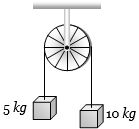
Two masses as shown are suspended from a massless pulley. Calculate the acceleration of the system when masses are left free
The length and breadth of a rectangular sheet are 16.2cm and 10.1cm, respectively. The area of the sheet in appropriate significant figures and error is:
For a satellite escape velocity is $11\, km/s$. If the satellite is launched at an angle of $60^°$ with the vertical, then escape velocity will be ........... $km/s$
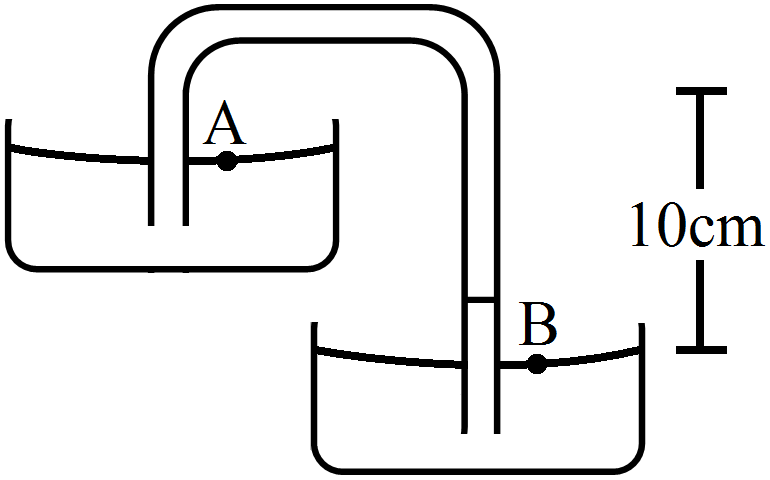
Figure shows a siphon. The liquid shown is water. The pressure difference Pa PA between the points A and B is the reading will be:
  1. 400 Nm−2
  2. 3000 Nm−2
  3. 1000 Nm−2
  4. zero.