MCQ
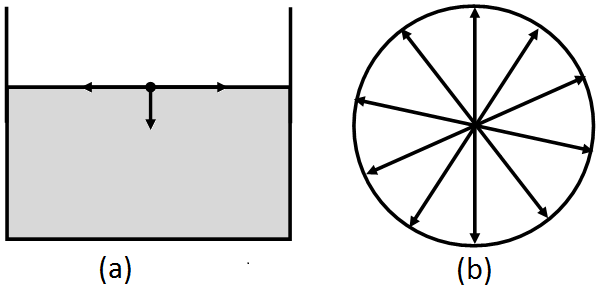
For a surface molecule:
  • A
    The net force on it is zero.
  • B
    There is a net downward force.
  • C
    The potential energy is more than that of a molecule inside.
  • Both $B$ and $C$

Answer

Correct option: D.
Both $B$ and $C$
A molecule viewed from the top to surface of the fluid. Force exerted on a molecule by all nearby molecule are equal and opposite, so net horizontal component of force is zero. as a molecule is viewed horizontally to the surface of fluid a vertically downward force acts on molecule due to which it does not escape from surface.

There is a net attractive force on molecules at surface acting downwards.
So the $P.E$ of molecules at the surface is negative to lower ones but in magnitude $\text{PE(mgh)}$ is more than that of the lower or inside molecules.

Need a full question paper?

Generate a complete, print-ready paper with questions like this in minutes — across 16+ boards, with answer keys.

Start Generating Free

Similar questions

A bomb of $12 \,kg$ explodes into two pieces of masses $4 \,kg $ and $8 \,kg$. The velocity of $8\,kg$  mass is $6 m/sec$. The kinetic energy of the other mass is ............. $\mathrm{J}$
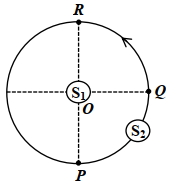
$S_1$ and $S_2$ are two identical sound sources of frequency $656 Hz$. The source $S_1$ is located at $O$ and $S_2$ moves anti-clockwise with a uniform speed $4 \sqrt{2} ms ^{-1}$ on a circular path around $O$, as shown in the figure. There are three points $P, Q$ and $R$ on this path such that $P$ and $R$ are diametrically opposite while $Q$ is equidistant from them. A sound detector is placed at point $P$. The source $S_1$ can move along direction $O P$.

[Given: The speed of sound in air is $324 ms ^{-1}$ ]

($1$) When only $S_2$ is emitting sound and it is $Q$, the frequency of sound measured by the detector in $Hz$ is. . . . . .

($2$) Consider both sources emitting sound. When $S_2$ is at $R$ and $S_1$ approaches the detector with a speed $4 ms ^{-1}$, the beat frequency measured by the detector is $\qquad$ $Hz$.
A stone is allowed to fall freely from rest. The ratio of the time taken to fall through the first meter and the second meter distance is:
A body is moving with uniform acceleration describes $40\, m$ in the first $5 \,sec$ and $65\, m$ in next $5 \,sec$. Its initial velocity will be........$m/s$
A motor car blowing a horn of frequency $124\,vib/sec$ moves with a velocity $72\, km/hr$ towards a tall wall. The frequency of the reflected sound heard by the driver will be .... $vib/sec$ (velocity of sound in air is $330\, m/s$)
A projectile is fired at a speed of $100\, m/sec$ at an angle of $37^o$ above the horizontal. At the highest point, the projectile breaks into two parts of mass ratio $1:3$, the smaller coming to rest. Then the distance of heavier part from the launching point is ........... $m$.
A bullet is dropped from the same height when another bullet is fired horizontally. They will hit the ground
A circular disc of mass $M$ and radius $R$ is rotating about its axis with angular speed $\omega_{1}$ If another stationary disc having radius $\frac{ R }{2}$ and same mass $M$ is dropped co-axially on to the rotating disc. Gradually both discs attain constant angular speed $\omega_{2}$. The energy lost in the process is $p \%$ of the initial energy. Value of $p$ is
Due to a force of $(6\hat i + 2\hat j)N$ the displacement of a body is $(3\hat i - \hat j)m$, then the work done is.....$J$
When compared with solids and liquids, the gases have