MCQ
For a transistor, in a common emitter arrangement, the alternating current gain $b$ is given by
  • $\beta=\left(\frac{\Delta I }{\Delta I _{ B }}\right)_{ vc }$
  • B
     $\beta=$ $\left(\frac{\Delta I _{ E }}{\Delta I _{ C }}\right)_{ v c }$
  • C
     $\beta=\left(\frac{\Delta I _{ c }}{\Delta I _{ E }}\right)_{ v c }$
  • D
     $\beta=\left(\frac{\Delta II _{ E }}{\Delta IC _{ C }}\right)_{ v c }$
Answer

Correct option: A.
$\beta=\left(\frac{\Delta I }{\Delta I _{ B }}\right)_{ vc }$
$\beta=\left(\frac{\Delta I _{ C }}{\Delta I _{ B }}\right)_{ vc }$

Need a full question paper?

Generate a complete, print-ready paper with questions like this in minutes — across 16+ boards, with answer keys.

Start Generating Free

Similar questions

Two wires $A$ and $B$ , having identical geometrical construction, are stretched from their natural length by small but equal amount. The Young's modulus of the wires are $Y_{\mathrm{A}}$ and $Y_{\mathrm{B}}$ whereas the densities are $\rho_{\mathrm{A}}>\rho_{\mathrm{B}^{+}}$It is given that $\mathrm{Y}_{\mathrm{A}}>\mathrm{Y}_{\mathrm{B}}$ and $\rho_{\mathrm{A}}>\rho_{\mathrm{B}^{+}} . \mathrm{A}$ transverse signal started at one end takes a time $\mathrm{t}_1$ to reach the other end for $A$ and $\mathrm{t}_2$ for $B.$
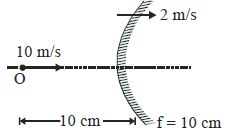
Find the velocity of image in situation as shown in figure.......$m/s$
In a radio tuning $RLC$ circuit, the half power frequencies are $100\,MHz$ and $120\,MHz$. Find the quality factor
The number of amplitude modulated broadcast stations that can be accommodated in a $300\, kHz$ band width for the highest modulating frequency $15\, kHz$ will be
The diffraction effect can be observed in
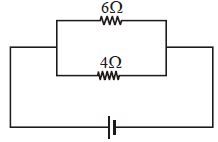
In the circuit shown, the power developed in the $6\,\Omega $ resistor is $6\,W.$ The power developed in the $4\,\Omega $ resistor is .............. $W$
In conductor when electrons move between two collisions, their paths are $... A...$ when external fields are absent and $... B...$ when external filed is present. Here, $A$ and $B$ refer to:
Photons of energy $7 \,eV$ are incident on two metals $A$ and $B$ with work functions $6 \,eV$ and $3 \,eV$, respectively. The minimum de-Broglie wavelengths of the emitted photoelectrons with maximum energies are $\lambda_A$ and $\lambda_B$ respectively, where $\lambda_A / \lambda_B$ is nearly
A square object of area $100\,sq.\,cm$ is placed perpendicular to the principle axis of a concave mirror. If the lateral magnification of the mirror, for the above object position, is $0.4,$ then the area of the image will be......$\,sq.\,cm$
An ellipsometer is an instrument for.