MCQ
For a zero order reaction
  • A
    The concentration of the reactant does not change during the reaction
  • B
    The concentration change only when the temperature changes
  • The rate remains constant throughout
  • D
    The rate of the reaction is proportional to the concentration
Answer

Correct option: C.
The rate remains constant throughout
c
(c)Rate of zero order reaction is independent of the concentration of the reactant and remains constant throughout the reaction.

Need a full question paper?

Generate a complete, print-ready paper with questions like this in minutes — across 16+ boards, with answer keys.

Start Generating Free

Similar questions

The number of electrons in the outermost shell of the $3d-$ transition elements generally remains
Among the following metal carbonyls, the $\mathrm{C}-\mathrm{O}$ bond order is lowest in
If $Ni ^{2+}$ is replaced by $Pt ^{2+}$ in the complex $\left[ NiCl _2 Br _2\right]^{2-}$, which of the following properties are expected to get changed?

$A.$ Geometry

$B.$ Geometrical isomerism

$C.$ Optical isomerism

$D.$ Magnetic properties

The reagent $(s)$ which can be used to distinguish acetophenone from benzophenone is (are)
The element the usually does $NOT$ show variable oxidation states is
The photoelectric current from Na (work function, $\left. w _{0}=2.3\, eV \right)$ is stopped by the output voltage of the cell 

$Pt ( s )\left| H _{2}( g , 1 bar )\right| HCl ( aq \cdot, pH =1)| AgCl ( s )| Ag ( s )$

The $pH$ of aq. HCl required to stop the photoelectric current from $K \left( w _{0}=2.25 eV \right),$ all other conditions remaining the same, is..........$\times 10^{-2}$ (to the nearest integer).

Given, $2.303 \frac{ RT }{ F }=0.06 V ; E _{ AgC1|Ag|C ^{-}}^{0}=0.22\, V$

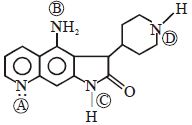
Most basic $'N'$ in following molecule is
The correct order of $K_a$ in aqueous solution at $298\, K$.
Which of the following is most common source of vitamin $C$ ?
Given below are two statements :

Statement I : $\left[\mathrm{Co}\left(\mathrm{NH}_3\right)_6\right]^{3+}$ is a homoleptic complex whereas $\left[\mathrm{Co}\left(\mathrm{NH}_3\right)_4 \mathrm{Cl}_2\right]^{+}$is a heteroleptic complex.

Statement II : Complex $\left[\mathrm{Co}\left(\mathrm{NH}_3\right)_6\right]^{3+}$ has only one kind of ligands but $\left[\mathrm{Co}\left(\mathrm{NH}_3\right)_4 \mathrm{Cl}_2\right]^{+}$has more than one kind of ligands.

In the light of the above statements, choose the correct answer from the options given below.