MCQ
For an ideal gas, in an isothermal process
  • A
    Heat content remains constant
  • B
    Heat content and temperature remain constant
  • Temperature remains constant
  • D
    None of the above

Answer

Correct option: C.
Temperature remains constant
c
(c)In isothermal process temperature remains constant.

Need a full question paper?

Generate a complete, print-ready paper with questions like this in minutes — across 16+ boards, with answer keys.
Start Generating Free

Similar questions

Young’s modulus of perfectly rigid body material is
At the instant $t = 0$ a force $F = kt$ ( $k$ is a constant) acts on a small body of mass $m$ resting on a smooth horizontal surface. The time, when body leaves the surface is
A particle is acted upon by a force of constant magnitude which is always perpendicular to the velocity of the particle. The motion of the particle takes place in a plane. It follows that:
  1. Its velocity is constant.
  2. Its acceleration is constant.
  3. Its kinetic energy is constant.
  4. It moves in a circular path.
A boy is sitting on the horizontal platform of a joy wheel at a distance of $5 \,m$ from the center. The wheel begins to rotate and when the angular speed exceeds $1 \,rad / s$, the boy just slips. The coefficient of friction between the boy and the wheel is $\left(g=10 \,m / s ^2\right)$
A block of mass $50\, kg$ slides over a horizontal distance of $1\, m$. If the coefficient of friction between their surfaces is $0.2$, then work done against friction is ......... $J$
When the separation between two charges is increased the electric potential energy of the charges.
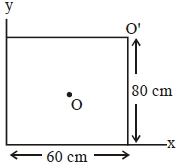
For a uniform rectangular sheet shown in the figure, the ratio of moments of inertia about the axes perpendicular to the sheet and passing through $O$ (the centre of mass) and $O ^{\prime}($ corner point $)$ is 
A particle of mass $m$ is acted upon by a force $F$ given by the empirical law $F = \frac{R}{{{t^2}}}\,v(t)$. If this law is to be tested experimentally by observing the motion starting from rest, the best way is to plot 
A point object of mass $m$ is kept at $(a, 0)$ along $x$-axis. What mass should be kept at $(-3 a, 0)$, so that centre of mass lies at origin?
The height of a swing changes during its motion from $0.1\, m$ to $2.5\, m$. The minimum velocity of a boy who swings in this swing is ..... $m/s$