MCQ
For an ideal gas
  • A
    The change in internal energy in a constant pressure process from temperature $T_1$ to $T_2$ is equal to $nC_v (T_2 -T_1)$ where$C _v$ is the molar specific heat at constant volume andnis the number of the moles of the gas.
  • B
    The change in internal energy of the gas and the work done by the gas are equal in magnitude in an adiabatic proces.
  • C
    The internal energy does not change in an isothermal process.
  • $A, B$ and $C$

Answer

Correct option: D.
$A, B$ and $C$
d

Need a full question paper?

Generate a complete, print-ready paper with questions like this in minutes — across 16+ boards, with answer keys.

Start Generating Free

Similar questions

When we clap our hands, the sound produced is best described by-

  1. $\text{p}=\text{p}_0\sin(\text{kx}-\omega\text{t})$

  2. $\text{p}=\text{p}_0\sin\text{kx}\cos\omega\text{t}$

  3. $\text{p}=\text{p}_0\cos\text{kx}\sin\omega\text{t}$

  4. $\text{p}=\sum\text{p}_{0\text{n}}\sin(\text{k}_\text{n}\text{x}-\omega_\text{n}\text{t}).$

The amplitude of a particle executing $SHM$ is $3\,cm$. The displacement at which its kinetic energy will be $25 \%$ more than the potential energy is: $.............cm$.
The displacement and the increase in the velocity of a moving particle in the time interval of $t$ to $(t+1) \mathrm{s}$ are $125 \mathrm{~m}$ and $50 \mathrm{~m} / \mathrm{s}$, respectively. The distance travelled by the particle in $(\mathrm{t}+2)^{\mathrm{th}} \mathrm{s}$ is__________ $\mathrm{m}$.
Two stones having different masses $m_1$ and $m_2$ are projected at an angle $\alpha$ and $\left(90^{\circ}-\alpha\right)$ with same speed from same point. The ratio of their maximum heights is
Work done by $0.1$ mole of a gas at ${27^o}C$ to double its volume at constant pressure is ....... $cal$ ($R = 2 \,cal\, mol^{-1}$ $^oC^{-1}$)
A particle is executing $SHM$ of amplitude $A,$ about the mean position $x = 0.$ Which of the following cannot be a possible phase difference between the positions of the particle at $x = +\,A/2$ and $x = - A/\sqrt {2} .$
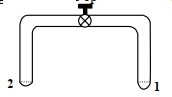
A glass tube of uniform internal radius ( $\mathrm{r}$ ) has a valve separating the two identical ends. Initially, the valve is in a tightly closed position. End $1$ has a hemispherical soap bubble of radius $\mathrm{r}$. End $2$ has sub-hemispherical soap bubble as shown in figure. Just after opening the valve,

Figure: $Image$

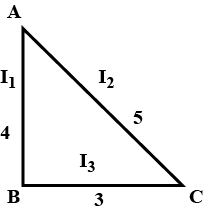
For the adjoining diagram, the incorrect relation between $I_{1}, I_{2}$ and $I_{3}$ is ($I-$ moment of inertia)
The unit of self inductance of a coil is
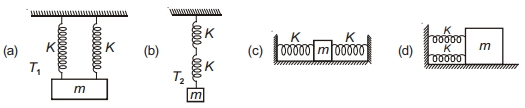
A mass $m$ is attached to two springs of same force constant $K$, as shown in following four arrangements. If $T_1, T_2, T_3$ and $T_4$ respectively be the time periods of oscillation in the following arrangements, in which case time period is maximum?