MCQ
For an inelastic collision, the value of e is
  • A
    greater than 1
  • less than 1
  • C
    equal to 1
  • D
    none of these

Answer

Correct option: B.
less than 1
less than 1

Need a full question paper?

Generate a complete, print-ready paper with questions like this in minutes — across 16+ boards, with answer keys.

Start Generating Free

Similar questions

A toy car with charge $q$ moves on a frictionless horizontal plane surface under the influence of a uniform electric field $\vec{E}$. Due to the force $q\vec{E}$, its velocity increases from $0$ to $6 \ m/s$ in one second duration. At that instant the direction of the field is reversed. The car continues to move for two more seconds under the influence of this field. The average velocity and the average speed of the toy car between $0$ to $3$ seconds are respectively
The process of changing some characteristics of a carrier wave in accordance with the incoming signal is called …………..
In the crystal of pure Ge or Si, each covalent bond consists of …………..
The turning effect of the applied force does NOT depend upon
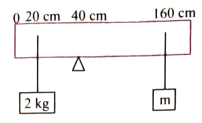
A uniform rod of length 200 cm and mass 500 g is balanced on a wedge placed at 40 cm mark. A mass of 2 kg is suspended from the rod at 20 cm and another unknown mass 'm' is suspended from the rod at 160 cm mark as shown in the figure. Find the value of 'm' such that the rod is in equilibrium. $\left( g =10 m / s ^2\right)$
Image
A projectile thrown from the ground has initial speed ' $u$ ' and its direction makes an angle ' $\theta$ ' with the horizontal. If at maximum height from ground, the speed of projectile is half its initial speed of projection, then the maximum height reached b the projectile is [ $g=$ acceleration due to gravity, $\sin 30^{\circ}=\cos 60^{\circ}$ $=0.5, \cos 30^{\circ}=\sin 60^{\circ}=\sqrt{3} / 2$ ]
Which of the following type of radiations are radiated by an oscillating electric charge?
A glass bottle completely filled with water is kept in the freezer. Why does it crack?
A block of mass m rests on a horizontal table with a co-efficient of static friction µ. What minimum force must be applied on the block to drag it on the table?