Question
For any solvent, the molal gradient constants value is certain. Why?

Answer

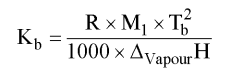
The molal elevation constant is calculated from the following formula :
Image
All the value present in this formula, R (gas constant or solution constant), $M _1$ (Molar mass of solvent, $T _{ b }$ (boiling point of solvent) and $\Delta_{\text {vaporisation }} H$ (enthalpy of vaporisation) of solvent are fixed, hence molar elevation constant $\left( K _{ b }\right)$ is also fixed.

Need a full question paper?

Generate a complete, print-ready paper with questions like this in minutes — across 16+ boards, with answer keys.
Start Generating Free

Similar questions

Give reasons for the following:
$a.$ The only oxidation state shown by Scandium is $+3.$
$b.\ [Ti(H_2O)_6]^{4+}$ is colourless.
$c.$ MnO is basic while $Mn_2O_7$ is acidic.
Name two water soluble vitamins, their sources and the diseases caused due to their deficiency in diet.
What purine and pyrimidine bases are present in DNA and RNA?
The decomposition of $\ce{NH3}$ on platinum surface,$\text{2NH}_{3}\text{(g)}\text{ }^{Pt}_\rightarrow\text{N}_{2}\text{(g)}+\text{3H}_{2}\text{(g)}$ is a zero order reaction with $k=\text{2.5}\times\text{10}^{-4}\text{Ms}^{-1}$ .
what are the rates of production of $N_2$ and $H_2$?
If a current of $0.5$ ampere flows through a metallic wire for $2$ hours, then how many electrons would flow through the wire?
Define azeotropes. What type of azeotrope is formed by positive deviation from Raoult's law? Give an example.
A first order reaction has a rate constant of $0.0051\ min^{–1}$. If we begin with $0.10 M$ concentration of the reactant, what concentration of reactant will remain in solution after $3$ hours?
How will the $pH$ of brine $(\ce{aq. NaCl}$ solution$)$ be affected when it is electrolysed?
For a reaction
$2\text{H}_2\text{O}_2\frac{\text{I}^-}{\text{alkaline medium}}2\text{H}_2\text{O}+\text{O}_2$
the proposed mechanism is as given below:
  1. $\text{H}_2\text{O}_2+\text{I}^{-}\xrightarrow{\ \ \ \ \ \ \ }\text{H}_2\text{O}+\text{IO}^{-}(\text{slow})$
  2. $\text{H}_2\text{O}_2+\text{IO}^{-}\xrightarrow{\ \ \ \ \ \ \ }\text{H}_2\text{O}+\text{I}^{-}+\text{O}_2(\text{fast})$
  1. Write rate law for the reaction.
  2. Write the overall order of reaction.
  3. Out of steps (1) and (2), which one is rate determining step?
$18g$ of glucose, $C_6H_{12}O_6($Molar Mass$=180g mol^{-1})$ is dissolved in $1\ kg$ of water in a sauce pan. At what temperature will this solution boil?
$(K_{b }$ for water $= 0.52 K \ kg mol^{-1}$, boiling point of pure water $= 373.15 K).$