Question
For any square matrix $A$ with real number entries, consider the following statements.
Assertion (A) : $A+A^{\prime}$ is a symmetric matrix.
Reason (R): $A-A^{\prime}$ is a skew-symmetric matrix.
Answer

(b) : Let $B=A+A^{\prime}$, then
$
B^{\prime}=\left(A+A^{\prime}\right)^{\prime}=A^{\prime}+\left(A^{\prime}\right)^{\prime}=A^{\prime}+A=A+A^{\prime}=B
$
Therefore, $B=A+A^{\prime}$ is a symmetric matrix.
Now, let $C=A-A^{\prime}$
$
C^{\prime}=\left(A-A^{\prime}\right)^{\prime}=A^{\prime}-\left(A^{\prime}\right)^{\prime}=A^{\prime}-A=-\left(A-A^{\prime}\right)=-C
$
Therefore, $C=A-A^{\prime}$ is a skew-symmetric matrix.

Need a full question paper?

Generate a complete, print-ready paper with questions like this in minutes — across 16+ boards, with answer keys.

Start Generating Free

Similar questions

Assertion (A) : Let $A=\{-1,1,2,3\}$ and $B=\{1,4,9\}$, where $f: A \rightarrow B$ given by $f(x)=x^2$, then $f$ is not one-one function.
Reason (R): If $x_1 \neq x_2 \Rightarrow f\left(x_1\right) \neq f\left(x_2\right)$, for every $x_1, x_2 \in$ domain, then $f$ is one-one.
Assertion $(A)$ : Minimum value of $(x-5)(x-7)$ is -1 .
Reason $(R)$ : Minimum value of $ax ^2+ bx + c$ is $\frac{4 a c-b^2}{4 a}$.
Assertion (A) : The matrix $\left(\begin{array}{llll}1 & 0 & 0 & 0 \\ 0 & 2 & 0 & 0 \\ 0 & 0 & 3 & 0\end{array}\right)$ is a diagonal matrix.
Reason (R) : $A=\left(a_{i j}\right)_{m \times m}$ is a square matrix such that entry $a_{i j}=0 \forall i, j$, then $A$ is called diagonal matrix.
Directions: In the following questions, the Assertions $(A)$ and Reason $(s) (R)$ have been put forward.
Read both the statements carefully and choose the correct alternative from the following:
Assertion $(A)$ If $x = at^2$ and $y = 2$ at where $‘t’$ is the parameter and ‘a’ is a constant, then $\frac{\text{d}^2\text{y}}{\text{dy}^2}= \frac{-1}{\text{t}^2}.$
Reason $(R) \frac{\text{d}^2\text{y}}{\text{dx}^2}=\frac{\text{d}^2\text{y}}{\text{dt}^2}\div\frac{\text{d}^2\text{x}}{\text{dt}^2}$
Directions: In the following questions, a statement of assertion $(A)$ is followed by a statement of reason $(R)$. Mark the correct choice as:
Assertion: If $X = {0, 1, 2}$ and the function defined by $f(x) = x^2 - 2$ is surjection then $Y = {-2, -1, 0}$.
Reason: If $f : X \rightarrow Y$ is surjective if $f(X) = Y$.
Directions: In the following questions, a statement of assertion $(A)$ is followed by a statement of reason $(R).$ Mark the correct choice as:
Assertion: The minor of the element $3$ in the matrix $\begin{bmatrix}2&3&1\\0&-2&4\\2&1&5\end{bmatrix}$ is $8$.
Reason: Minor of an element $a_{ij}$ of a matrix is the determinant obtained by deleting its $j^{th}$ row and $i^{th}$ column.
Assertion $(A) :$ The absolute maximum and minimum values of $f(x)=x^2 \sqrt{1+x}$ in $\left[-1, \frac{1}{2}\right]$ are $\frac{\sqrt{6}}{8}$ and 0 respectively.
Reason $(R) :$ Let $f$ be a differentiable function on $I$ and $x_0$ be any interior point of $I$. If $f$ attains its absolute maximum or minimum value at $x_0$, then $f^{\prime}\left(x_0\right)=0$.
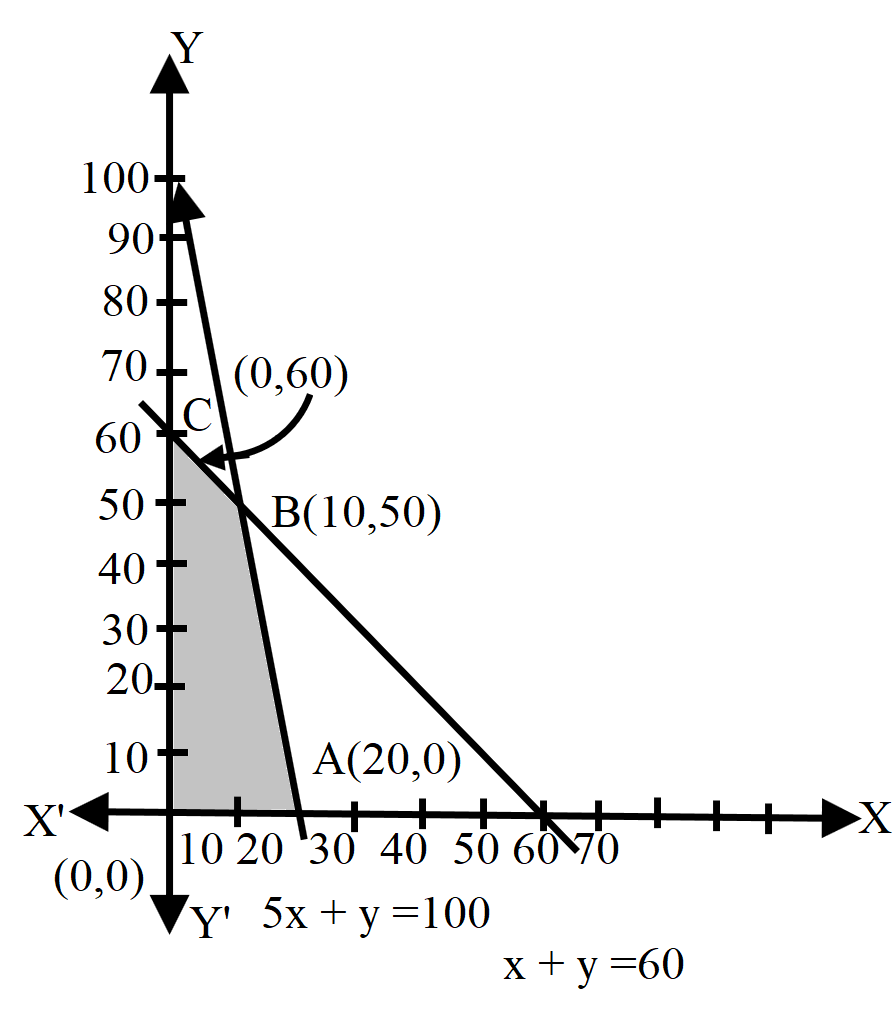
Directions: In the following questions, the Assertions (A) and Reason(s) (R) have been put forward. Read both the statements carefully and choose the correct alternative from the following: Consider, the graph of constraints stated as linear inequalities as below: $5\text{x}+\text{y}\leq100,\text{x}+\text{y}\leq60,\text{x},\text{y}\geq0.$
Assertion (A): (25, 40) is an infeasible solution of the problem. Reason (R): Any point inside the feasible region is called an infeasible solution.
  1. Both A and R are true and R is the correct explanation of A
  2. Both A and R are true but R is NOT the correct explanation of A
  3. A is true but R is false.
  4. A is false but R is true.
Directions: In the following questions, a statement of assertion $(A)$ is followed by a statement of reason $(R).$ Mark the correct choice as$:$
Assertion: If $\text{A}=\begin{pmatrix}0 & 2 & -1\\ -2 & 0 & 3 \\ 1& -3 & 0 \end{pmatrix},$ then $A^{-1}$ is symmetric matrix.
Reason: If $A$ is skew symmetric matrix then $A^{-1}$ is skew symmetric matrix.
Directions: In the following questions, a statement of assertion (A) is followed by a statement of reason (R). Mark the correct choice as:
Assertion: If the matrix $\text{P}=\begin{pmatrix}0&2\text{b}&-2\\3&1&3\\3\text{a}&3&3\end{pmatrix}$ is a symmetric matrix, then $\text{a}=-\frac{2}{3}$ and $\text{b}=-\frac{2}{3}.$
Reason: If P is a symmetric matrix, then P' = P.
  1. Both A and R are true and R is the correct explanation of A.
  2. Both A and R are true but R is not the correct explanation of A.
  3. A is true but R is false.
  4. A is false but R is true.
  5. Both A and R are false.