MCQ
For fastest rate of reaction, $X_2$ must be
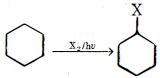
- ✓$F_2$
- B$Cl_2$
- C$Br_2$
- D$I_2$
Generate a complete, print-ready paper with questions like this in minutes — across 16+ boards, with answer keys.
$\Delta U = 2.1\ kcal, \, \Delta S = 20\, cal\, K^{-1}$ at $300\, K$ Hence, $\Delta G$ is ............ $\mathrm{kcal}$
$' A ^{\prime} \stackrel{ HNO _3}{\longrightarrow} X ^{\prime} \stackrel{ NaBH _4}{\longrightarrow} \underset{\text { Chiral compound }}{\text { } B ^{}}$ $X$ is $.......$.
Assertion $(A) :$ $I - Cl$ is more reactive than $I _{2}$.
Reason $(R):$ $I - Cl$ bond is weaker than $I-I$ bond.
In the light of the above statements, choose the most appropriate answer from the options given below:
$2H^+ + 2e^- + \frac{1}{2}O_2\longrightarrow H_2O_{(l)} ; $
$E^o = +1.23\, V$
$Fe^{2+} + 2e^- \longrightarrow Fe_{(s)} ;\ E^o = -0.44\,V$
| $column 1$ | $column 2$ | $column 3$ |
| $(I)$ Toluene | $(i)$ $\mathrm{NaOH} / \mathrm{Br}_2$ | $(P)$ Condensation |
| $(II)$ Acetophenone | $(ii)$ $\mathrm{Br}_2 / \mathrm{h} v$ | $(Q)$ Carboxylation |
| $(III)$ Benzaldehyde | $(iii)$ $\left(\mathrm{CH}_3 \mathrm{CO}\right)_2 \mathrm{O} / \mathrm{CH}_3 \mathrm{COOK}$ | $(R)$ Substion |
| $(IV)$ Phenol | $(iv)$ $\mathrm{NaOH} / \mathrm{CO}_2$ | $(S)$ Haloform |
($1$) For the synthesis of benzoic acid, the only $CORRECT$ combination is
$[A] (III) (iv) (R)$ $[B] (IV)(ii) (P)$ $[C] (I) (iv) (Q)$ $[D] (II) (i) (S)$
($2$) The only CORRECT combination in which the reaction proceeds through radical mechanism is
$[A] (I)$ $(ii) (R)$ $[B] (II) (iii) (R)$ $[C] (III) (ii) (P)$ $[D] (IV) (i) (Q)$
($3$) The only CORRECT combination that gives two different carboxylic acids is
$[A] (IV) (iii) (Q)$ $[B] (III) (iii) (P)$ $[C] (II) (iv) (R)$ $[D] (I) (i) (S)$
Given the answer quetion ($1$) ($2$) and ($3$)
