MCQ
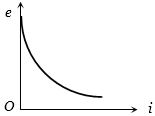
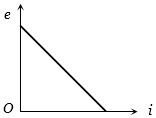
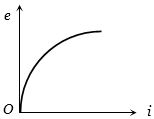
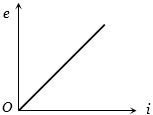
For previous objective, which of the following graphs is correct
  • A

  • B

  • C


Answer

Correct option: D.

d
(d)If at any instant, current through the circuit is i then applying Kirchoffs voltage law,$iR + e = E \Rightarrow e = E - iR.$ Therefore, graph between $e$ and $i$ will be a straight line having negative slope and having a positive intercept.

Need a full question paper?

Generate a complete, print-ready paper with questions like this in minutes — across 16+ boards, with answer keys.
Start Generating Free

Similar questions

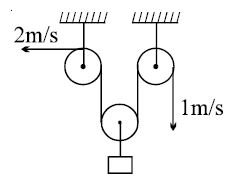
Find the velocity of the hanging block if the velocities of the free ends of the rope are as indicated in the figure.
A beam of electrons and protons move parallel to each other in the same direction, then they
A parallel plate capacitor has capacitance $C$ . If charges of the plates are $Q$ and $-3Q$ , find the potential difference between the plates
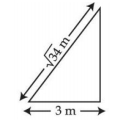
A $\sqrt{34}\,m$ long ladder weighing $10\,kg$ leans on a frictionless wall. Its feet rest on the floor $3\,m$ away from the wall as shown in the figure. If $F_{f}$ and $F_{w}$ are the reaction forces of the floor and the wall, then ratio of $F _{ a } / F _{f}$ will be:

(Use $\left.g=10\,m / s ^{2}\right)$

A lift of mass $1000\,kg$ is moving with an acceleration of $1$ $m/{s^2}$ in upward direction. Tension developed in the string, which is connected to the lift, is  ........... $N$  $(g= 9.8\ m/{s^2})$
If a charged particle enters perpendicularly in the uniform magnetic field then
Which one of the following statements is not true about the motion of a projectile?
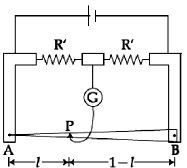
In a meter bridge, the wire of length $1\, m$ has a nonuniform cross-section such that, the variation $\frac{{dR}}{{d\ell }}$ of its resistance $R$ with length $\ell $ is $\frac{{dR}}{{d\ell }} \propto \frac{1}{{\sqrt \ell  }}$ Two equal resistances are connected as shown in the figure. The galvanometer has zero deflection when the jockey is at point $P$. What is the length $AP$ ? ................ $m$
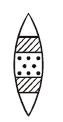
A convex lens is made up of three different material as shown in figure. For a point object placed on its axis. The number of images formed are
The process in which no heat enters or leaves the system is termed as