MCQ
For question two statements are given $-$ one labelled Assertion $(A)$ and the other labelled Reason $(R)$. Select the correct answer to these questions from the codes $(a), (b), (c)$ and $(d)$ as given below.
Assertion $(A)$ : Between any two given energy levels, the number of absorption transitions is always less than the number of emission transitions.
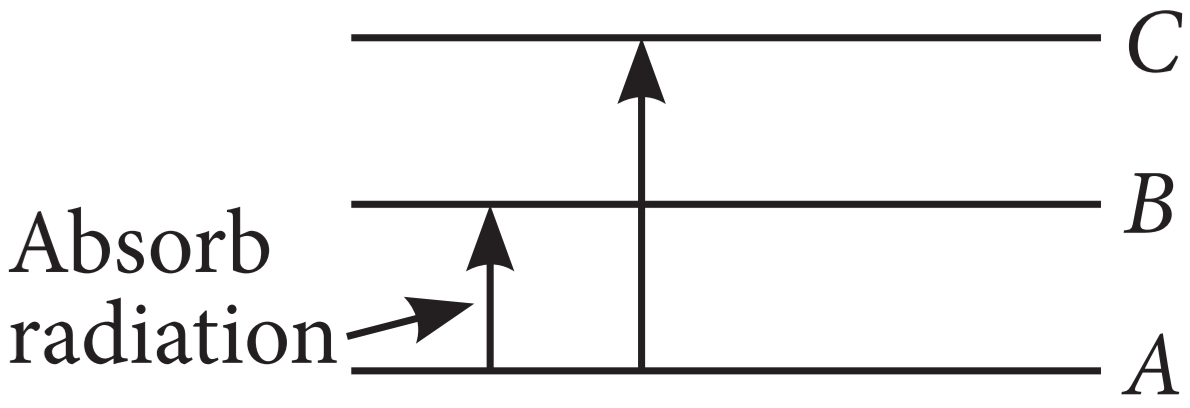
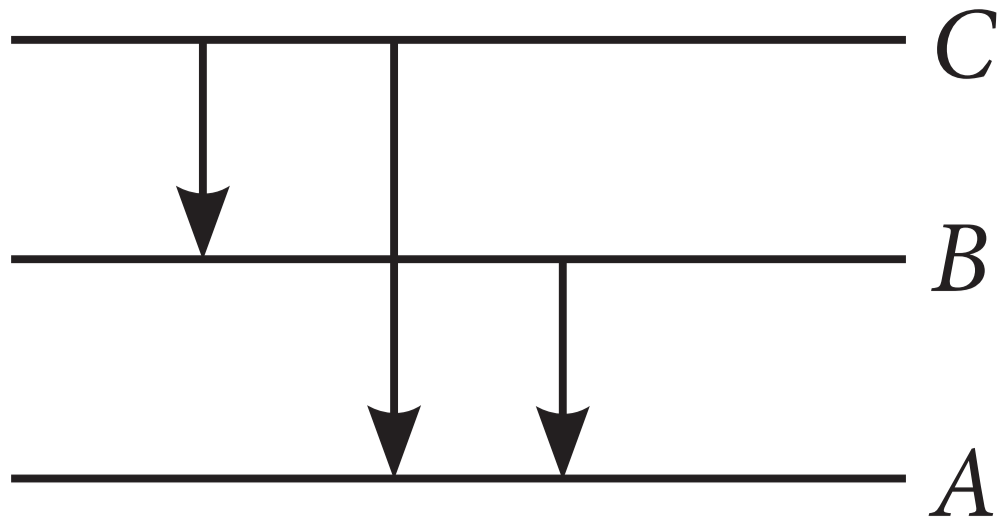
Reason $(R)$ : Absorption transitions start from the lowest energy level only and may end at any higher energy level. But emission transitions may start from any higher energy level and end at any energy level below it.
  • Both $A$ and $R$ are true, and $R$ is the correct explanation of $A$.
  • B
    Both $A$ and $R$ are true, but $R$ is $\text{NOT}$ the correct explanation of $A$.
  • C
    $A$ is true, but $R$ is false.
  • D
    $A$ is false and $R$ is also false.

Answer

Correct option: A.
Both $A$ and $R$ are true, and $R$ is the correct explanation of $A$.
Both $A$ and $R$ are true, and $R$ is the correct explanation of $A.$
Absorption transition

Two possibilities in absorption transition. Emission transition

Three possibilities in emission transition.
Therefore, number of absorption transition $ < $ number of emission transition.
For any two states $A$ and $B$ such that $E_A < E_8$
We have absorption spectrum for $A ​​\rightarrow B$ transition and emission $B \rightarrow A$.
But most of the time atoms are in ground state, absorption is only from the ground state.

Need a full question paper?

Generate a complete, print-ready paper with questions like this in minutes — across 16+ boards, with answer keys.

Start Generating Free

Similar questions

For two statements are given-one labelled Assertion (A) and the other labelled Reason (R). Select the correct answer to these questions from the codes (a), (b), (c) and (d) as given below.
  1. Both A and R are true, and R is the correct explanation of A.
  2. Both A and R are true, but R is not the correct explanation of A.
  3. A is true, but R is false.
  4. A is false, and R is also false.
Assertion: Fuse wire must have high resistance and low melting point.
Reason: Fuse is used for small current flow only.
Two statements are given-one labelled Assertion (A) and the other labelled Reason (R). Select the correct answer to these questions from the codes (a), (b ), (c) and (d) as given below.
  1. Both A and R are true and R is the correct explanation of A.
  2. Both A and Rare true but R is NOT the correct explanation of A.
  3. A is true but R is false.
  4. A is false and R is also false.
Assertion (A): Self-inductance is called the inertia of electricity.
Reason (R): Self-inductance is the phenomenon, according to which an opposing induced e.m.f. is produced in a coil as a result of change in current or magnetic flux linked with the coil.
Assertion (A): On increasing the current sensitivity of a galvanometer by increasing the number of turns may not necessarily increase its voltage sensitivity.
Reason(R): The resistance of the coil of the galvanometer increases on increasing the number of turns.
Two statements are given-one labelled Assertion (A) and the other labelled Reason (R). Select the correct answer to these questions from the codes (a), (b), (c) and (d) as given below.
  1. Both A and R are true and R is the correct explanation of A.
  2. Both A and R are true but R is not the correct explanation of A.
  3. A is true but R is false.
  4. A is false and R is also false.
Assertion: Electromagnetic waves exert pressure called radiation pressure.
Reason: Electromagnetic waves carries energy.
For two statements are given$-$one labelled Assertion $(A)$ and the other labelled Reason $(R).$ Select the correct answer to these questions from the codes $(a), (b), (c)$ and $(d)$ as given below.
Assertion $(A):$ If a conducting medium is placed between two charges, then electric force between them becomes zero.
Reason $(R):$ Reduction in a force due to introduced material is inversely proportional to its dielectric constant.
For two statements are given-one labelled Assertion (A) and the other labelled Reason (R). Select the correct answer to these questions from the codes (a), (b), (c) and (d) as given below.
  1. Both A and R are true, and R is the correct explanation of A.
  2. Both A and R are true, but R is not the correct explanation of A.
  3. A is true but R is false.
  4. A is false and R is also false.
Assertion (A): A point charge is brought in an electric field. The field at a nearby point is increase, whatever be the nature of the charge.
Reason (R): The electric field is independent of the nature of charge.
For question two statements are given-one labelled Assertion (A) and the other labelled Reason (R). Select the correct answer to these questions from the codes (a), (b), (c) and (d) as given below.
  1. Both A and R are true, and R is the correct explanation of A.
  2. Both A and R are true, but R is NOT the correct explanation of A.
  3. A is true, but R is false.
  4. A is false and R is also false.
Assertion (A): The force of repulsion between atomic nucleus and $\alpha$-particle varies with distance according to inverse square law.
Reason (R): Rutherford did $\alpha$-particle scattering experiment.
Directions: In the following questions, the Assertions (A) and Reason(s) (R) have been put forward. Read both the statements carefully and choose the correct alternative from the following:
Assertion: We cannot think of a magnetic field configuration with three poles.
Reason: A bar magnet does exert a torque on itself due to its own field.
  1. Both Assertion and Reason are correct and Reason is the correct explanation for Assertion.
  2. Both Assertion and Reason are correct but Reason is not the correct explanation for Assertion.
  3. Assertion is correct but Reason is incorrect.
  4. Both Assertion and Reason are incorrect.
For two statements are given-one labelled Assertion (A) and the other labelled Reason (R). Select the correct answer to these questions from the codes (a), (b), (c) and (d) as given below.
  1. Both A and R are true and R is the correct explanation of A.
  2. Both A and R are true but R is not the correct explanation of A.
  3. A is true but R is false.
  4. A is false and R is also false.
Assertion: The core of transformer is made laminated in order to increase the eddy currents.
Reason: The sensitivity of transformer increases with increase in the eddy currents.
For two statements are given-one labelled Assertion (A) and the other labelled Reason (R). Select the correct answer to these questions from the codes (a), (b), (c) and (d) as given below.
  1. Both A and R are true, and R is the correct explanation of A.
  2. Both A and R are true, but R is not the correct explanation of A.
  3. A is true but R is false.
  4. A is false and R is also false.
Assertion (A): Three equal charges are situated on a circle of radius r such that they form on equilateral triangle, then the electric field intensity at the centre is zero.
Reason (R): The force on unit positive charge at the centre, due to the three equal charges are represented by the three sides of a triangle taken in the same order. Therefore, electric field intensity at centre is zero.