MCQ
For question two statements are given$-$one labelled Assertion and the other labelled Reason. Select the correct answer to these questions from the codes $(a), (b), (c)$ and $(d)$ as given below.
Assertion: Quantitative inheritance is called polygenic inheritance.
Reason: Several genes control the expression of a trait.
  • Both assertion and reason are true and reason is the correct explanation of assertion.
  • B
    Both assertion and reason are true but reason is not the correct explanation of assertion.
  • C
    Assertion is true but reason is false.
  • D
    Both assertion and reason are false.

Answer

Correct option: A.
Both assertion and reason are true and reason is the correct explanation of assertion.
Quantitative inheritance is a type of inheritance controlled by one or more genes in which the dominant alleles have cumulative effect with each dominant allele expressing a part or unit of the trait, the full trait being shown only when all the dominant alleles are present. The genes involved in quantitative inheritance are called polygenes. A polygene is defined as a gene where a dominant allele controls only a unit or partial quantitative expression of a trait.

Need a full question paper?

Generate a complete, print-ready paper with questions like this in minutes — across 16+ boards, with answer keys.

Start Generating Free

Similar questions

Read the following and answer any four questions from $(i)$ to $(v)$ given below:
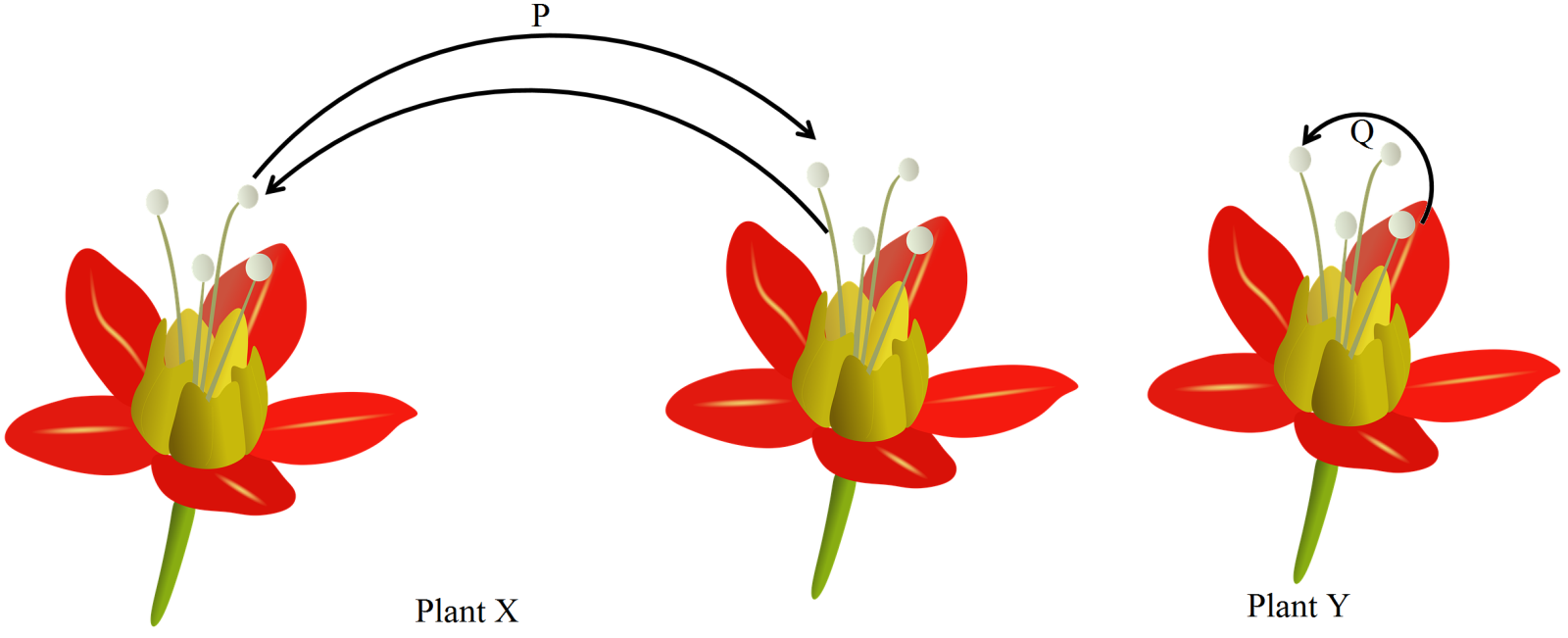
In angiosperms, the pollen grains are being transferred from the anther to the stigma and is termed pollination. This phenomenon was first discovered by Camerarius $(1694)$ in the end of seventeenth century. Pollen grains are immobile. They cannot reach the stigma by themselves. An external agent is required for this. The pollination is mainly of two types$-$self pollination and cross pollination. The diagram given below shows two plants of the same species showing different types of pollination.
  1. What is transferred between the plants in the process indicated by arrow $P?$
  1. Ova.
  2. Pollen.
  3. Nutrients.
  4. Seeds.
  1. Which of the following statements is correct regarding processes $P, Q$ and $R?$
  1. Processes $P, Q$ and $R$ introduce genetic variability in the offspring of sexually reproducing plants $X$ and $Y.$
  2. Wind serves as agent for process $Q$ if plants $X$ and $Y$ belong to Genus Salvia.
  3. Flowers of plants $X$ and $Y$ need to produce odour and nectar for completion of processes $P$ and $Q$ if they are entomophilous.
  4. If plants $X$ and $Y$ belong to Genus Cannabis, then their flowers need to produce sticky and heavy pollens in very small amount for accomplishment of process $Q.$
  1. Identify the processes $P, Q$ and $R.$
S. No $P$ $Q$ $R$
$(a)$
Geitonogamy
Xenogamy
Autogamy
$(b)$
Allogamy
Chasmogamy
Cleistogamy
$(c)$
Autogamy
Geitonogamy
Xenogamy
$(d)$
Geitonogamy
Allogamy
Autogamy
  1. In Catliarantl1us, the growth of style brings the stigma in contact of ripe anthers present on the mouth of corolla tube. This is an example of:
  1. Homogamy.
  2. Cleistogamy.
  3. Geitonogamy.
  4. Xenogamy.
  1. Which of the given processes represents a type of pollination that would result in greater adaptability of the particular species to potential environmental changes?
  1. $P.$
  2. $Q.$
  3. $R.$
  4. All of these.
Bt toxin is harmful to insects like :
For question, two statements are given$-$one labelled Assertion and the other labelled Reason. Select the correct answer to these questions from the codes $(a), (b), (c)$ and $(d)$ as given below.
Assertion : Proto$-$oncogenes are cellular genes required for normal growth.
Reason: Under normal conditions, they could lead to the oncogenic transformation of the cell.
For question, two statements are given-one labelled Assertion and the other labelled Reason. Select the correct answer to these questions from the codes $(a), (b), (c)$ and $(d)$ as given below.
Assertion: Same $\text{tRNA}$ can recognise more than one codons differing only at the third position.
Reason : The specificity of a codon is particularly determined by the first two bases.
Two statements are given-one labelled Assertion and the other labelled Reason. Select the correct answer to these questions from the codes $(a), (b), (c)$ and $(d)$ as given below.
Assertion: An organism which acts as herbicide is called bioherbicide.
Reason: Phytophthora palmivora is a mycoherbicide.
For question two statements are given$-$one labelled Assertion and the other labelled Reason. Select the correct answer to these questions from the codes $(a), (b), (c)$ and $(d)$ as given below.
Assertion: The soil profiles of grassland, forest and desert biomes differ from each other.
Reason: Soil profile develops due to weathering process, accumulation of organic matter and leaching of mineral matter.
Two statements are given-one labelled Assertion and the other labelled Reason. Select the correct answer to these questions from the codes $(a), (b), (c)$ and $(d)$ as given below.
Assertion: Rhizobium forms nodules on the roots of legume plants.
Reason: Rhizobium fixes atmospheric nitrogen into organic forms which is used by the plant as nutrients.
For question, two statements are given$-$one labelled Assertion and the other labelled Reason. Select the correct answer to these questions from the codes $(a), (b), (c)$ and $(d)$ as given below.
Assertion : Psychotropic drugs affect behaviour and mental activities
Reason: Tranquillizer, a psychotropic drug, decrease tension and anxiety.
For question two statements are given$-$one labelled Assertion and the other labelled Reason. Select the correct answer to these questions from the codes $(a), (b), (c)$ and $(d)$ as given below.
Assertion: Amensalism is a negative interaction between two living individuals.
Reason: In amensalism, allochemics are secreted by one individual.
For question two statements are given $-$ one labelled Assertion and the other labelled Reason. Select the correct answer to these questions from the codes $(a), (b), (c)$ and $(d)$ as given below.
Assertion : Many endemic species are seen to flourish in sacred forests.
Reason : Sacred forests are undisturbed forest patches and biodiversity rich areas.