MCQ
For question two statements are given$-$one labelled Assertion and the other labelled Reason. Select the correct answer to these questions from the codes $(a), (b), (c)$ and $(d)$ as given below.
Assertion: Mutations are discontinuous variations.
Reason: Mutations occur suddenly.
  • Both assertion and reason are true and reason is the correct explanation of assertion.
  • B
    Both assertion and reason are true but reason is not the correct explanation of assertion.
  • C
    Assertion is true but reason is false.
  • D
    Both assertion and reason are false.

Answer

Correct option: A.
Both assertion and reason are true and reason is the correct explanation of assertion.
Mutations are sudden unpredictable inheritable departures from the normal type without any intermediate stage. Discontinuous variations form the basis of mutation theory of evolution which was proposed by Vries $(1902).$

Need a full question paper?

Generate a complete, print-ready paper with questions like this in minutes — across 16+ boards, with answer keys.

Start Generating Free

Similar questions

For question, two statements are given$-$one labelled Assertion and the other labelled Reason. Select the correct answer to these questions from the codes $(a), (b), (c)$ and $(d)$ as given below.
Assertion: Ribosomes attached to endoplasmic reticulum release proteins into lumen of $\text{ER}.$
Reason: Such proteins are used for formation of hydrolytic enzymes or are modified.
For question, two statements are given$-$one labelled Assertion and the other labelled Reason. Select the correct answer to these questions from the codes $(a), (b), (c)$ and $(d)$ as given below. Assertion: Sequences of bases in one polynucleotide chain of $\text{DNA}$ can determine the sequence of bases in the other chain.
Reason: In a $\text{DNA}$, amount of adenine equals that of thymine and amount of guanine equals that of cytosine, i.e., $A = T$ and $C = G$.
For two statements are given$-$one labelled Assertion and the other labelled Reason. Select the correct answer to these questions from the codes $(a), (b), (c)$ and $(d)$ as given below.
Assertion: One pollen mother cell forms four microspores.
Reason: Microspores are formed due to reduction division.
For question two statements are given$-$one labelled Assertion and the other labelled Reason. Select the correct answer to these questions from the codes $(a), (b), (c)$ and $(d)$ as given below.
Assertion: Hybrids are generally superior than their parents.
Reason: All the dominant traits are present in the hybrid.
For question two statements are given$-$one labelled Assertion and the other labelled Reason. Select the correct answer to these questions from the codes $(a), (b), (c)$ and $(d)$ as given below.
Assertion : Test cross is a back cross.
Reason: In test cross, individual is crossed with recessive paren.
Read the following and answer any four questions from $(i)$ to $(v)$ given below:
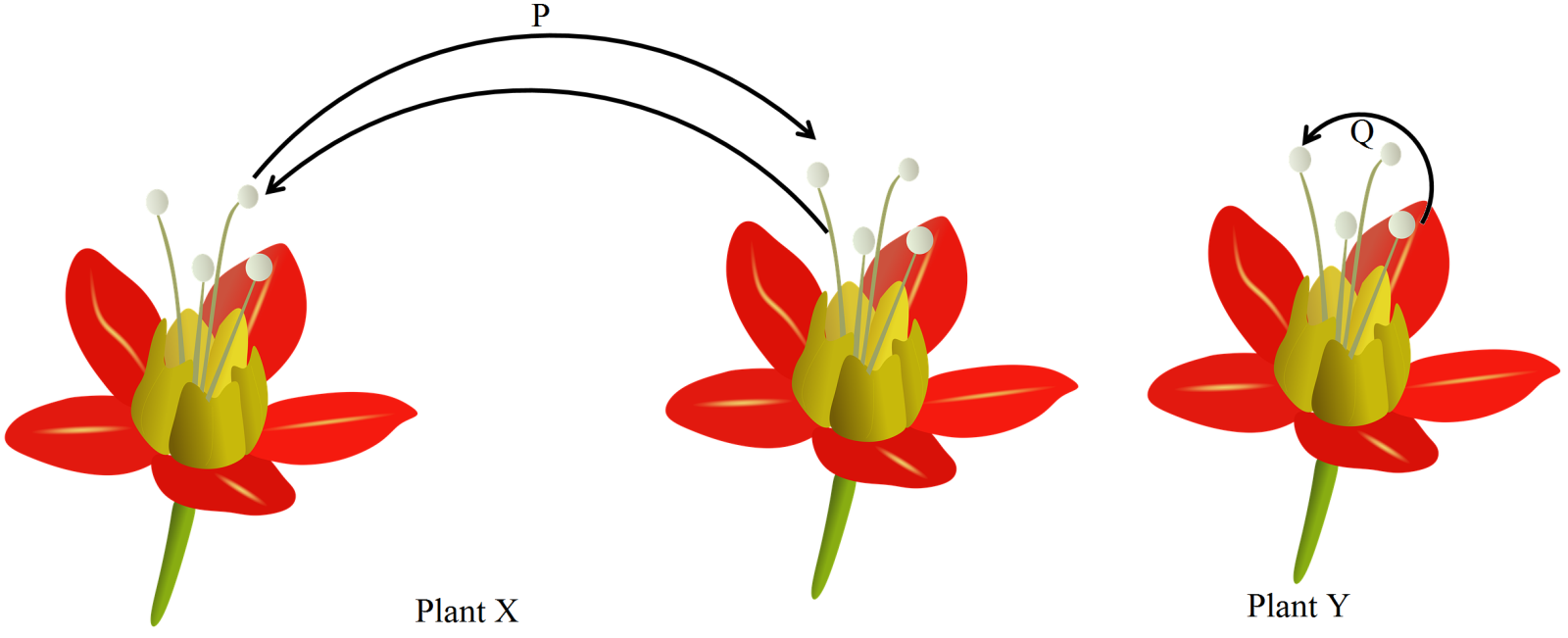
In angiosperms, the pollen grains are being transferred from the anther to the stigma and is termed pollination. This phenomenon was first discovered by Camerarius $(1694)$ in the end of seventeenth century. Pollen grains are immobile. They cannot reach the stigma by themselves. An external agent is required for this. The pollination is mainly of two types$-$self pollination and cross pollination. The diagram given below shows two plants of the same species showing different types of pollination.
  1. What is transferred between the plants in the process indicated by arrow $P?$
  1. Ova.
  2. Pollen.
  3. Nutrients.
  4. Seeds.
  1. Which of the following statements is correct regarding processes $P, Q$ and $R?$
  1. Processes $P, Q$ and $R$ introduce genetic variability in the offspring of sexually reproducing plants $X$ and $Y.$
  2. Wind serves as agent for process $Q$ if plants $X$ and $Y$ belong to Genus Salvia.
  3. Flowers of plants $X$ and $Y$ need to produce odour and nectar for completion of processes $P$ and $Q$ if they are entomophilous.
  4. If plants $X$ and $Y$ belong to Genus Cannabis, then their flowers need to produce sticky and heavy pollens in very small amount for accomplishment of process $Q.$
  1. Identify the processes $P, Q$ and $R.$
S. No $P$ $Q$ $R$
$(a)$
Geitonogamy
Xenogamy
Autogamy
$(b)$
Allogamy
Chasmogamy
Cleistogamy
$(c)$
Autogamy
Geitonogamy
Xenogamy
$(d)$
Geitonogamy
Allogamy
Autogamy
  1. In Catliarantl1us, the growth of style brings the stigma in contact of ripe anthers present on the mouth of corolla tube. This is an example of:
  1. Homogamy.
  2. Cleistogamy.
  3. Geitonogamy.
  4. Xenogamy.
  1. Which of the given processes represents a type of pollination that would result in greater adaptability of the particular species to potential environmental changes?
  1. $P.$
  2. $Q.$
  3. $R.$
  4. All of these.
Two statements are given $-$ one labelled Assertion and the other labelled Reason. Select the correct answer to these questions from the codes $(a), (b), (c)$ and $(d)$ as given below.
Assertion : Both the passenger and vehicle $\text{DNAs}$ are treated separately with separate restriction endonuclease.
Reason : Ligation is done by the use of alkaline phosphatase and $\text{DNA}$ ligase.
Read the following and answer any four questions from $(i)$ to $(v)$ given below:
The pollen grains or microspores are the male reproductive bodies of a flower and are contained in the pollen sac or microsporangia. Each pollen grain consists of a single microscopic cell, possessing two coats: the exine and the in tine. The exine of a pollen grain is made of chemically stable material. Because of this, pollen grains are often very well preserved for thousands of years in soil and sediments.
  1. One of the most resistant biological material present in the exine of pollen grain is:
  1. Pectocellulose.
  2. Sporopollenin.
  3. Suberin.
  4. Cellulose.
  1. The exine possesses one or more thin places known as:
  1. Raphe.
  2. Germ pores.
  3. Hilum.
  4. Endothecium.
  1. What is the function of germ pore?
  1. Emergence of radicle.
  2. Absorption of water for seed germination.
  3. Initiation of pollen tube.
  4. All of these.
  1. What is the key advantage to the plant for having such strong pollen grain walls?
  1. It protects the vital genetic material in the pollen grain.
  2. It allows pollen to serve as a valuable fossil record for the study of ancient plants.
  3. It prevents the pollen tube from growing out before the pollen grain reaches the stigma of a compatible species.
  4. It gives weight to the pollen grain, allowing it to cling better to the body surfaces of insect pollinators.
  1. The number of germ pores in dicots and monocots respectively are:
  1. One and three.
  2. Three and two.
  3. Two and three.
  4. Three and one.
For question, two statements are given$-$one labelled Assertion and the other labelled Reason. Select the correct answer to these questions from the codes $(a), (b), (c)$ and $(d)$ as given below.
Assertion : Proto$-$oncogenes are cellular genes required for normal growth.
Reason: Under normal conditions, they could lead to the oncogenic transformation of the cell.
Mention the name of two common diseases that can be treated by medicines that contain biological products of transgenic animals.