MCQ

For reading small letters with a lens:

  • A
    One has to keep a convex lens at a distance between F and 2F from the book.
  • B
    One has to keep a concave lens at a distance less than the focal length from the book
  • C
    One has to keep concave lens at a distance between F and 2F from the book
  • D
    One has to keep a convex lens at a distance less than the an focal length from the book

Answer

  1. One has to keep a convex lens at a distance less than the an focal length from the book

Explanation:

A concave lens always produces virtual, erect and diminished images and the decrease in the size of the image depends on the position of the object.

Concave lens will shrink the size of the already small letters.

A convex lens produces real and virtual, erect and inverted, diminished, same sized and magnified image of the object, depending upon the position of the object on the principal axis.

When the object is placed between F and 2F of convex lens, an enlarged but inverted image of the object is formed. The magnified image makes it easier to read small letters but the inverted image is undesirable.

When the object is placed at a distance less than the focal length of convex lens, an enlarged and erect image of the object is formed, which makes it easier to read small letters.

Need a full question paper?

Generate a complete, print-ready paper with questions like this in minutes — across 16+ boards, with answer keys.

Start Generating Free

Similar questions

Photoelectric emission is observed from a metallic surface for frequencies  and  of the incident light rays (. If the maximum values of kinetic energy of the photoelectrons emitted in the two cases are in the ratio of 1 : k, then the threshold frequency of the metallic surface is

(a)  

(b)

(c)

(d)

The Rutherford a-particle experiment shows that most of the a-particles pass through almost unscattered while some are scattered through large angles. What information does it give about the structure of the atom

(a) Atom is hollow

(b) The whole mass of the atom is concentrated in a small centre called nucleus

(c) Nucleus is positively charged

(d) All the above

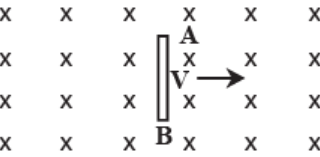
A rod AB moves with a uniform velocity v in a uniform magnetic field as shown in figure:
Image
An alternating voltage $\text{E}=50\sqrt{2}\sin(100\text{t})$ V is connected to a $1\mu\text{F}$ capacitor through an ac ammeter. What will be the reading of the ammeter?

A plano-convex lens when silvered in the plane side behaves like a concave mirror of focal length 30cm. However, when silvered on the convex side it behaves like a concave mirror of focal length 10 cm. Then the refractive index of its material will be

(a) 3.0

(b) 2.0

(c) 2.5

(d) 1.5

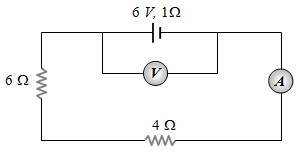
In the circuit shown here, the readings of the ammeter and voltmeter are

(a) 6 A, 60 V

(b) 0.6 A, 6 V

(c) 6/11 A, 60/11 V

(d) 11/6 A, 11/60 V

For which frequency of $A C$ reactive inductance of 1 Henry inductor will be 1000 $\Omega$ ?
Following operations can be performed on a capacitor:
X - connect the capacitor to a battery of emf $\in.$
Y - disconnect the battery.
Z - reconnect the battery with polarity reversed.
W - insert a dielectric slab in the capacitor.
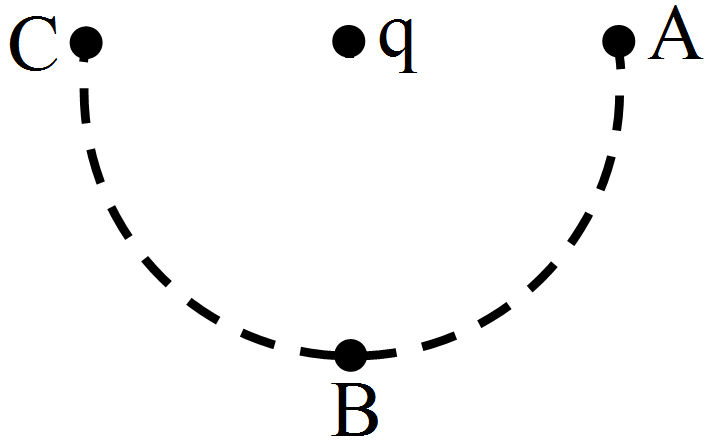
Consider the situation of figure. The work done in taking a point charge from P to A is WA, from P to B is WB and from P to C is WC.

  1. WA < WB < WC
  2. WA > WB > WC
  3. WA = WB = WC
  4. None of these.

Six protons and six neutrons are brought together to form a carbon nucleus, but the mass of the carbon nucleus is less than the sum of the masses of the individual particles due to the mass defect, This deducted mass has been: