MCQ
For rotational equilibrium,
  • A
    $\sum^\limits{\text{n}}_\limits{\text{i}=1}\text{F}_{\text{net}}=0$
  • B
    $\sum^\limits{\text{n}}_\limits{\text{i}=1}\tau_{\text{net}}=0$
  • C
    Both (a) and (b) are the necessary conditions for the rotational equilibrium.
  • D
    Both (a) and (b) are not necessary for rotational equilibrium.
Answer

  1. $\sum^\limits{\text{n}}_\limits{\text{i}=1}\tau_{\text{net}}=0$

Need a full question paper?

Generate a complete, print-ready paper with questions like this in minutes — across 16+ boards, with answer keys.

Start Generating Free

Similar questions

A truck on a straight road starts from rest, accelerating at $2.00 m / s ^2$ until it reaches a speed of $20.0 m / s$. Then the truck travels for 20.0 s at a constant speed until the brakes are applied, stopping the truck in a uniform manner in an additional 5.00 s . What is the average velocity in $m / s$ of the truck for the motion described?
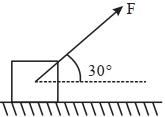
As shown in the figure a block of mass $10\,kg$ lying on a horizontal surface is pulled by a force $F$ acting at an angle $30^{\circ}$, with horizontal. For $\mu_{ s }=0.25$, the block will just start to move for the value of $F..........\,N$ : $\left[\right.$ Given $\left.g =10\,ms ^{-2}\right]$
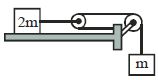
Consider the situation shown in figure. All the surfaces are smooth. The tension in the string connected to $2\,m$ is
Weight of a body decreases by $1.5 \%$, when it is raised to a height $h$ above the surface of earth. When the same body is taken to same depth $h$ in a mine, its weight will show ........
A camet (assumed to be in an elliptical orbit around the sun) is at a distance of $0.4 \,AU$ from the sun at the perihelion. If the time period of the camet is $125 \,yr$.the aphelion distance is ........... $AU$ ($AU$ : Astronomical Unit)
Newton's third law of motion leads to the law of conservation of
Identify the pair of physical quantities that have same dimensions
An aeroplane is moving with horizontal velocity $u$ at height $h$. The velocity of a packet dropped from it on the earth's surface will be ($g$ is acceleration due to gravity)
A spring having a spring constant $‘K’$ is loaded with a mass $‘m’$. The spring is cut into two equal parts and one of these is loaded again with the same mass. The new spring constant is
Dependence of intensity of gravitational field  $(E)$ of earth with distance $(r)$ from centre of earth is correctly represented by