Question
For solving pair of equation, in this exercise use the method of elimination by equating coefficients :$2 x-3 y-3=0; \frac{2 x}{3}+4 y+\frac{1}{2}=0$

Answer

$2 x-3 y-3=0$
$\Rightarrow 2 x-3 y=3\dots .....(1)$
$\frac{2 x}{3}+4 y+\frac{1}{2}=0$
Multiply by $6 ,$
$6 \times \frac{2 x}{3}+6 \times 4 y+\frac{1}{2} \times 6=0 \times 6$
$4 x+24 y=-3\ldots . . .(2)$
Multiplying equation no. $(1)$ by $8$
$16 x-24 y=24\dots .....(3)$
Adding equation $(3)$ and $(2)$
$16 x-24 y =24$
$+4 x+24 y =-3$
$20 x =21$
$x =\frac{21}{20}$
From $(1)$
$\therefore 2\left[\frac{21}{20}\right]-3 y=3$
$ \therefore-3 y=3-\frac{21}{20}$
$ \therefore y=-\frac{3}{10}$

Need a full question paper?

Generate a complete, print-ready paper with questions like this in minutes — across 16+ boards, with answer keys.
Start Generating Free

Similar questions

The square on the diagonal of a cube has an area of $441 \ cm^2. $Find the length of the side and total surface area of the cube.
Find the amount and the compound interest payable annually on the following :$Rs.10000$ for $2 \frac{1}{2}$ years at $6\%$ per annum.
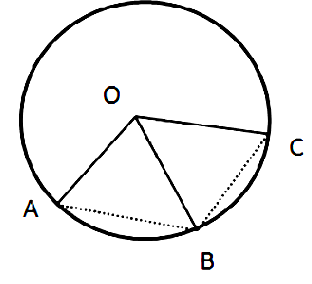
In the given figure, the lengths of arcs $AB$ and $BC$ are in the ratio $3:2.$ If $\angle AOB = 96^\circ $,find: $(i) \angle BOC ;(ii) \angle ABC$
If 2 is added to each of the two given numbers, then their ratio becomes 1 : 2. However, if 4 is subtracted from each of the given numbers, the ratio becomes 5 : 11. Find the numbers.
[Hint. Let the given numbers be $x$ and $y$. Then, $\frac{x+2}{y+2}=\frac{1}{2}$ and $\frac{x-4}{y-4}=\frac{5}{11}$.]
Construct a parallelogram $ABCD$ in which $AB = 4.5\ cm, \angle A = 105^\circ $ and the distance between $AB$ and $CD$ is $3.2\ cm.$
Draw parallelogram $\text{ABCD}$ with the following data:$A B=6 \ cm , A D=5 \ cm$ and $\angle D A B=45^{\circ}$.Let $A C$ and $D B$ meet in $O$ and let $E$ be the mid$-$point of $B C$. Join $O E$.Prove that:(i) $OE \| AB;(ii)OE =\frac{1}{2} AB$.
If $a+\frac{1}{a}=6$ and $a \neq 0$ find:$(i) a-\frac{1}{a}(ii) a^2-\frac{1}{a^2}$
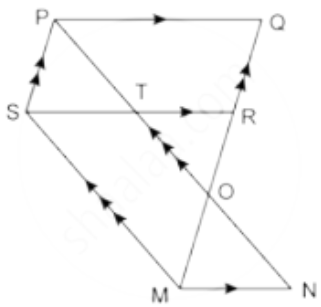
In the given figure, $PQ \| SR \| MN, PS \|| QM$ and $SM \| PN$. Prove that: $ar. (\text{SMNT}) = ar. (\text{PQRS).}$
Image
Draw the graph of the equation$4x + 3y + 6 = 0$From the graph, find :$(i) y_1$, the value of y, when $x = 12.(ii) y_2$​​​​​​​, the value of $y$, when $x = - 6.$
Which of the following pairs of triangles are congruent?Give reasons;$\triangle ABC;(\angle B = 90^\circ,BC = 6\ cm,AB = 8\ cm);\triangle PQR;(\angle Q = 90^\circ,PQ = 6\ cm,PR = 10\ cm).$