Question
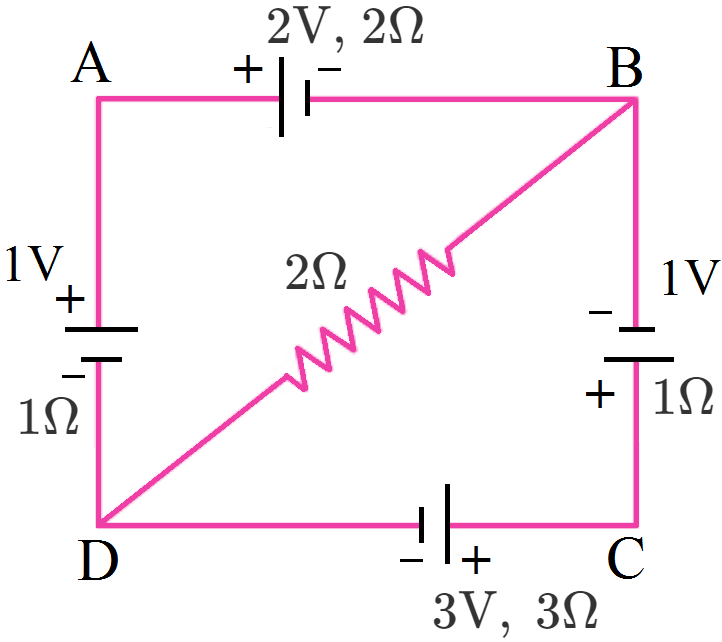
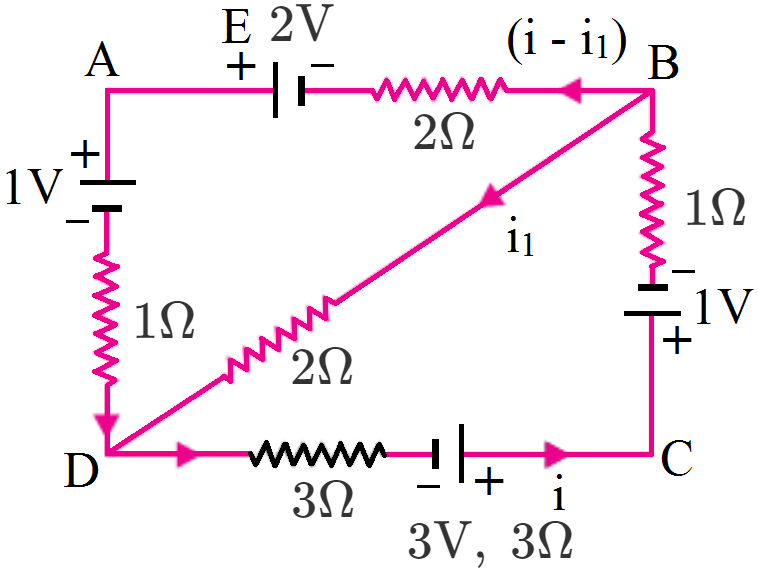
For the circuit shown here, calculate the potential difference between points B and D.

Answer

According to Kirchhoff’s first law the distribution of currents is shown in fig.

Applying Kirchhoff’s second law to mesh BADB, $–2(i – i_1) +2 – 1 – 1. (i – i_1) + 2i_1 = 0$
$\Rightarrow 3i – 5i_1 = 1 …(i)$
Applying Kirchhoff’s law to mesh DCBD, $-3i + 3 - 1 - 1\times i - 2i_1 = 0$
$\Rightarrow 4i + 2i_1 = 2$ Or $2i + i_1 = 1 …(ii)$
Multiplying equation (ii) with 5, we get
$10i + 5i_1 = 5 …(iii)$
Adding (i) and (iii), we get $13\text{i}=6\Rightarrow\text{i}=\frac{6}{13}\text{A}$
From (ii), $\text{i}_1=1-2\text{i}=1-\frac{12}{13}=\frac{1}{13}\text{A}$
Potential difference between B and D is,
$\text{V}_\text{n}-\text{v}_\text{n}=\text{i}-1\times2=\frac{2}{13}\text{V}$

Need a full question paper?

Generate a complete, print-ready paper with questions like this in minutes — across 16+ boards, with answer keys.
Start Generating Free

Similar questions

Explain direct current direct emf and draw their graphs. Define alternating current and explain in detail.
Explain "Electron Theory of Electric Charge".
Explain ac voltage applied on a capacitor.Explain charging and discharging of a capacitor.
$a.$ Derive an expression for the energy stored in a parallel plate capacitor of capacitance $C$ when charged up to voltage $V$. How is this energy stored in the capacitor?
$b.$ A capacitor of capacitance $1 \mu F$ is charged by connecting a battery of negligible internal resistance and emf $10 V$ across it. Calculate the amount of charge supplied by the battery in charging the capacitor fully.
A hemispherical portion of the surface of a solid glass sphere $(\mu=1.5)$ of radius r is silvered to make the inner side reflecting. An object is placed on the axis of the hemisphere at a distance 3r from the centre of the sphere. The light from the object is refracted at the unsilvered part, then reflected from the silvered part and again refracted at the unsilvered part. Locate the final image formed.
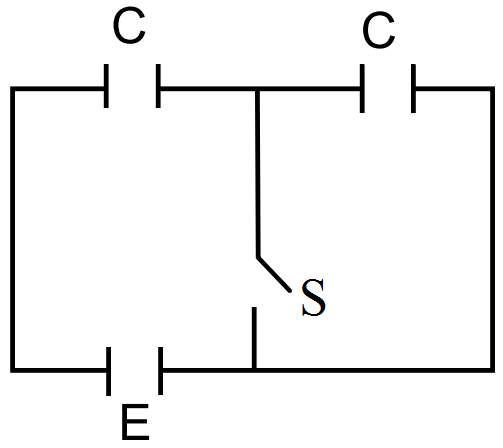
Consider the situation shown in figure. The switch S is open for a long time and then closed:
  1. Find the charge flown through the battery when the switch S is closed.
  2. Find the work done by the battery.
  3. Find the change in energy stored in the capacitors.
  4. Find the heat developed in the system.
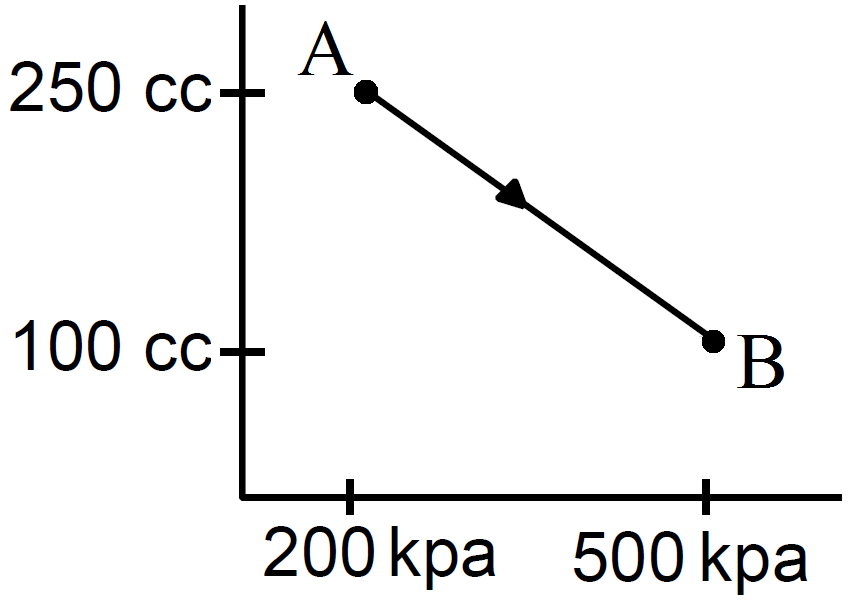
A gas is taken along the path AB as shown in figure. If 70cal of heat is extracted from the gas in the process, calculate the change in the internal energy of the system.
An ornament weighing 36g in air, weighs only 34g in water. Assuming that some copper is mixed with gold to prepare the ornament, find the amount of copper in it. Specific gravity of gold is 19.3 and that of copper is 8.9.
The current in an ideal, long solenoid is varied at a uniform rate of 0.01A/s. The solenoid has 2000 turns/m and its radius is 6.0cm.
  1. Consider a circle of radius 1.0cm inside the solenoid with its axis coinciding with the axis of the solenoid. Write the change in the magnetic flux through this circle in 2.0 seconds.
  2. Find the electric field induced at a point on the circumference of the circle.
  3. Find the electric field induced at a point outside the solenoid at a distance 8.0cm from its axis.
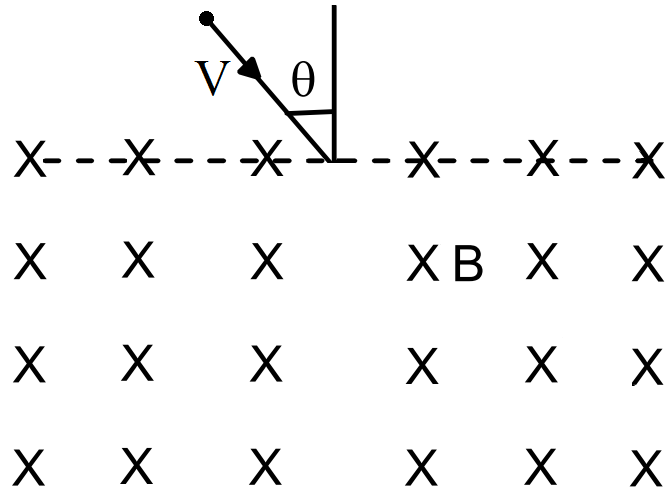
A particle of mass m and positive charge q, moving with a uniform velocity v, enters a magnetic field B, as shown,
  1. Find the radius of the circular arc it describes in the magnetic field.
  2. Find the angle subtended by the arc at the centre.
  3. How long does the particle stay inside the magnetic field?
  4. Solve the three parts of the above problem if the charge q on the particle is negative.