Question
  1. For the complex $[Fe(H_2O)_6]^{3+},$ write the hybridization, magnetic character and spin of the complex. $($At. number: $Fe = 26)$
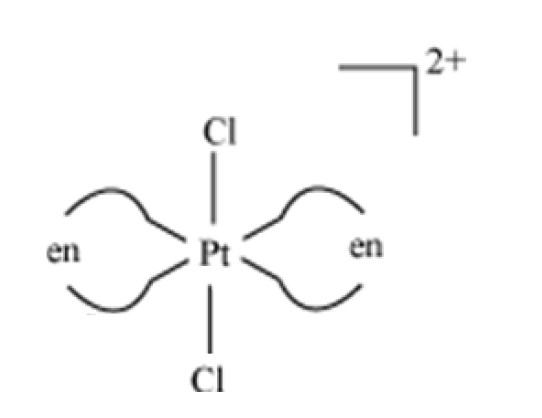
  2. Draw one of the geometrical isomers of the complex $[Pt(en)_2Cl_2]^{2+}$ which is optically inactive.
Answer

  1. $sp^3d^2, $ paramagnetic, high spin.
  2.  

Need a full question paper?

Generate a complete, print-ready paper with questions like this in minutes — across 16+ boards, with answer keys.

Start Generating Free

Similar questions

Write a note on oxidation reaction of alcohols. $\#\#\#$ Explain oxidation of alcohols with chemical reactions.
After the ban on plastic bags, students of one school decided to make the people aware of the harmful effects of plastic bags on environment and Yamuna River. To make the awareness more impactful, they organised rally by joining hands with other schools and distributed paper bags to vegetable vendors, shopkeepers and departmental stores. All students pledged not to use polythene bags in future to save Yamuna River.
After reading the above passage, answer the following questions:
  1. What values are shown by the students?
  2. What are biodegradable polymers? Give one example.
  3. Is polythene a condensation or an addition polymer?
The cell in which the following reaction occurs:
$2\text{Fe}^{3+}(\text{aq})+2\text{I}^-(\text{aq})\rightarrow2\text{Fe}^{2+}(\text{aq})+\text{I}_2(\text{s})\ \text{has}\ \text{E}^\circ_{\text{cell}}$ = 0.236 V at 298 K. Calculate the standard Gibbs energy and the equilibrium constant of the cell reaction.
Explain dehydration of alcohols with chemical equations. And also give the order for relative ease of dehydration of alcohols.
Write formula of a chelate complex and give its IUPAC name.
Match the items given in Column I with the items given in Column II.
 
Column I
 
Column II
$(i)$
$Mg$ in solid state
$(a)$
$p-$Type semiconductor.
$(ii)$
$MgCl_2$ in molten state
$(b)$
$n-$Type semiconductor.
$(iii)$
Silicon with phosphorus
$(c)$
Electrolytic conductors.
$(iv)$
Germanium with boron
$(d)$
Electronic conductors.
What is limiting molar conductivity ? Explain relation between molar conductivity and concentration of solution with strong electrolyte.
Explain the structure and function of salt bridge of molten galvanic cell.
Give reasons for the following:
  1. Ethyl iodide undergoes $S_N2$ reaction faster than ethyl bromide.
  2. $(\pm)$ 2-Butanol is optically inactive.
  3. C-X bond length in halobenzene is smaller than C-X bond length in $CH_3-X$.
  1. Write the name of two monosaccharides obtained on hydrolysis of lactose sugar.
  2. Why Vitamin C cannot be stored in our body?
  3. What is the difference between a nucleoside and nucleotide?