MCQ
For the complexes showing the square pyramidal structure, the $d-$ orbital involved  in the hybridisation is
  • $d_{x^2-y^2}$
  • B
    $d_{z^2}$
  • C
    $d_{xy}$
  • D
    $d_{xz}$

Answer

Correct option: A.
$d_{x^2-y^2}$
a
When five ligands are attached to the central metal atom, the central metal atom undergoes $d s p^{3}$ hybridization.

When $d_{z^{2}}$ orbital is involved in the hybridization, the geometry is trigonal bipyramidal.

When $d_{x^{2}-y^{2}}$ orbital is involved in the hybridization, the geometry is square pyramidal.

Hence the correct option is A.

Need a full question paper?

Generate a complete, print-ready paper with questions like this in minutes — across 16+ boards, with answer keys.

Start Generating Free

Similar questions

The number of photons emitted by a monochromatic (single frequency) infrared range finder of power $1\, \mathrm{~mW}$ and wavelength of $1000 \,\mathrm{~nm}$, in $0.1$ $second$ is $\mathrm{x}\, \times 10^{13}$. The value of $\mathrm{x}$ is ..... .

(Nearest integer)

$\left(\mathrm{h}=6.63 \times 10^{-34}\, \mathrm{Js}, \mathrm{c}=3.00 \times 10^{8} \,\mathrm{~ms}^{-1}\right)$

The rate constant for the reaction $2N_2O_5 \to  4NO_2 + O_2$ is $3.0\times10^{-5}\, sec^{-1}$. If rate is $2.40\times10^{-5}\, M\, sec^{-1}$, then the concentration of $N_2O_5$ (in $M$) is ?
The $IUPAC$ name of

$\begin{array}{*{20}{c}}
  {BrC{H_2} - CH - CO - C{H_2} - C{H_2}C{H_3}} \\ 
  {|\,\,\,\,\,\,\,\,\,\,\,\,\,\,\,\,\,\,\,\,\,\,\,\,\,\,\,\,\,\,\,\,\,\,} \\ 
  {CON{H_2}\,\,\,\,\,\,\,\,\,\,\,\,\,\,\,\,\,\,\,\,} 
\end{array}$

is :

Tollen's reagent is
The bond order in $CO_3^{2 - }$ ion between $C - O$ is
The correct order of $S-S$ bond length in following oxyanions is

$(I)$ $S_2O_4^{2-}$   $(II)$ $S_2O_5^{2-}$    $(III)$ $S_2O_6^{2-}$
In a reaction, reactant ‘$A$’ decomposes $10\%$ in $1$ hour, $20\%$ on $2$ hour and $30\%$ in $3$ hour. The unit of rate constant of this reaction is
Which of the following alkyl groups has the maximum $+ I$ effect
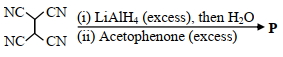
The total number of $\mathrm{sp}^2$ hybridised carbon atoms in the major product $P$ (a non-heterocyclic compound) of the following reaction is. . . . . . .
$0.01\,\,M\,HA\,(aq.)$ is  $2\%$  ionized $; [OH^-]$  of solution is