Question
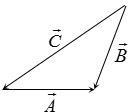
For the figure

Answer

(c)

Need a full question paper?

Generate a complete, print-ready paper with questions like this in minutes — across 16+ boards, with answer keys.
Start Generating Free

Similar questions

The magnifying glass is made of combination of lenses of power $+20D$ and $-4D$. If the distance of distinct vision is $25\,cm$, calculate the size of an object $2\,cm$ height seen through the magnifying glass 
$y = 2\, (cm)\, sin\,\left[ {\frac{{\pi t}}{2} + \phi } \right]$ what is the maximum acceleration of the particle doing the $S.H.M.$
A body of mass $3\, kg$ is under a constant force which causes a displacement $s$ in metres in it, given by the relation $s=$$\frac{1}{3}{t^2}$ , where $t$ is in seconds. Work done by the force in $2$ seconds is
Consider the diffraction pattern obtained from the sunlight incident on a pinhole of diameter $0.1\, \mu m$. If the diameter of the pinhole is slightly increased, it will affect the diffraction pattern such that :
A bullet of mass $2\, gm$ is having a charge of $2\,\mu C$. Through what potential difference must it be accelerated, starting from rest, to acquire a speed of $10\,m/s$
Static friction between two surfaces
A particle moves with constant angular velocity in a circle. During the motion its
In Young's double slit interference experiment , the slit widths are in the ratio $1 : 25$. Then the ratio of intensity at the maxima and minima in the interference pattern is
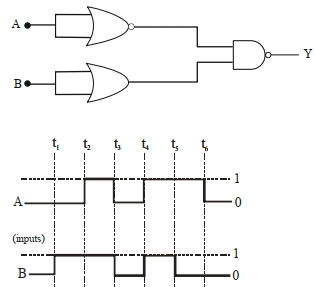
For the following circuit and given inputs $A$ and $B$, choose the correct option for output ' $Y$ '
A convex lens $A$ of focal length $20 cm$ and a concave lens $B$ of focal length $5 cm$ are kept along the same axis with the distance $d$ between them. If a parallel beam of light falling on $A$ leaves $B$ as a parallel beam, then distance $d$ in $cm$ will be