MCQ
For the following two reactions, which statement is.true?
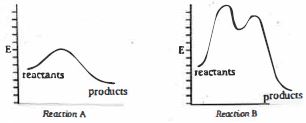
  • Reaction $A$  is faster and less exergonic then $B$
  • B
    Reaction $B$ is faster and more exergonic than $A$
  • C
    Reaction $A$ is faster and less endergonic than $B$
  • D
    Reaction $B$ is faster and more endergonic than $A$
Answer

Correct option: A.
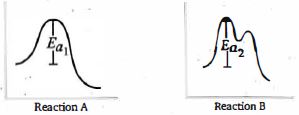
Reaction $A$  is faster and less exergonic then $B$
a
$E_{a_1} < E_{a_2}$ and reaction is exothermic

Need a full question paper?

Generate a complete, print-ready paper with questions like this in minutes — across 16+ boards, with answer keys.

Start Generating Free

Similar questions

An octahedral complex with molecular composition $M.5\, NH_3.Cl.SO_4$ has two isomers, $A$ and $B$. The solution of $A$ gives a white precipitate with $AgNO_3$ solution and the solution of $B$ gives white precipitate with $BaCl_2$ solution. The type of isomerism exhibited by the complex is
The electric conduction of a salt solution in water depends on the
In the reaction scheme shown below $Q , R$ and $S$ are the major products.

The correct structure of

The molar conductivity of a conductivity cell filled with $10$ moles of $20\,mL\,NaCl$ solution is $\Lambda_{ m 1}$ and that of $20$ $moles$ another identical cell heaving $80$ $mL NaCl$ solution is $\Lambda_{ m 2}$, The conductivities exhibited by these two cells are same.The relationship between $\Lambda_{m 2}$ and $\Lambda_{m 1}$ is$........$
Addition of $OsO_4$ to cyclopentene would give a product which is
Which of the following is non-polar
Which of following will gives benzene with benzene diazonium chloride ?
Activation energy of a chemical reaction can be determined by:
Match the reactions (in the given stoichiometry of the reactants) in List-$I$ with one of their products given in List-$II$ and choose the correct option.

List-$I$ List-$II$
$\mathrm{P}_2 \mathrm{O}_3+3 \mathrm{H}_2 \mathrm{O} \rightarrow$ $\mathrm{P}(\mathrm{O})\left(\mathrm{OCH}_3\right) \mathrm{Cl}_2$
$\mathrm{P}_4+3 \mathrm{NaOH}+3 \mathrm{H}_2 \mathrm{O} \rightarrow$ $\mathrm{H}_3 \mathrm{PO}_3$
$\mathrm{PCl}_5+\mathrm{CH}_3 \mathrm{COOH} \rightarrow$ $\mathrm{PH}_3$
$\mathrm{H}_3 \mathrm{PO}_2+2 \mathrm{H}_2 \mathrm{O}+4 \mathrm{AgNO}_3 \rightarrow$ $\mathrm{H}_3 \mathrm{PO}_4$


The cell reaction $Mn + 2Ag_{\left( {{C_1}} \right)}^ + \left( {aq} \right) \to Mn_{\left( {{C_2}} \right)}^{ + 2}\left( {aq} \right) + 2Ag$ is represented by