MCQ
For the following two reactions, which statement is.true?
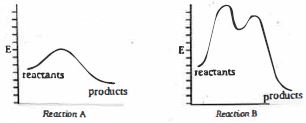
  • Reaction $A$  is faster and less exergonic then $B$
  • B
    Reaction $B$ is faster and more exergonic than $A$
  • C
    Reaction $A$ is faster and less endergonic than $B$
  • D
    Reaction $B$ is faster and more endergonic than $A$
Answer

Correct option: A.
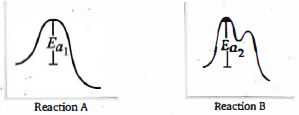
Reaction $A$  is faster and less exergonic then $B$
a
$E_{a_1} < E_{a_2}$ and reaction is exothermic

Need a full question paper?

Generate a complete, print-ready paper with questions like this in minutes — across 16+ boards, with answer keys.

Start Generating Free

Similar questions

Which of the following compounds is oxidised to prepare methyl ethyl ketone
The oxidation state of molybdenum in its oxo complex species $[Mo_2O_4(C_2H_4)_2(H_2O_2)]^{2-}$ is
What is the sign of $\Delta G^o$ and the value of $K$ for an electrochemical cell for which cell $E_{cell}^o = 0.80\,V$ ?
Choose the correct statements from the following

$A$. $\mathrm{Mn}_2 \mathrm{O}_7$ is an oil at room temperature

$B$. $\mathrm{V}_2 \mathrm{O}_4$ reacts with acid to give $\mathrm{VO}_2^{2+}$

$C$. $\mathrm{CrO}$ is a basic oxide

$D$. $\mathrm{V}_2 \mathrm{O}_5$ does not react with acid

Choose the correct answer from the options given below :

Bessemer converter is used in the manufacture of
On treating a compound with warm dil. $H _{2} SO _{4}$, gas $X$ is evolved which turns $K _{2} Cr _{2} O _{7}$ paper acidified with dil. $H _{2} SO _{4}$ to a green compound $Y. X$ and $Y$ respectively are
The brown complex obtained in the detection of nitrate radical is formulated as $\left[\mathrm{Fe}\left(\mathrm{H}_2 \mathrm{O}\right)_5 \mathrm{NO}\right] \mathrm{SO}_4$. What is the oxidation number of Fe in this complex?
If 2 g NaOH is mixed in 250 gram of water, then the concentration of the solution will be:
Which of the following statements is wrong?
Given below are two statement one is labeled as

Assertion $(A)$ and the other is labeled as Reason $(R)$. Assertion $(A)$: $\mathrm{CH}_2=\mathrm{CH}-\mathrm{CH}_2-\mathrm{Cl}$ is an example of allyl halide

Reason$(R)$: Allyl halides are the compounds in which the halogen atom is attached to $\mathrm{sp}^2$ hybridised carbon atom.

In the light of the two above statements, choose the $most \ appropriate$ answer from the options given below: