MCQ
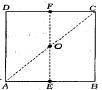
For the given uniform square lamina $ABCD$ , whose centre is $O$,
  • A
    $I_{AC}$ =$\sqrt 2 $$I_{EF}$
  • B
    $\sqrt 2 $$I_{AC}=I_{EF}$
  • C
    $I_{AO}=3I_{EF}$
  • $I_{AC}=I_{EF}$

Answer

Correct option: D.
$I_{AC}=I_{EF}$
d
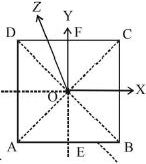
By the theorem of perpendicular axes,

${I_z} = {I_x} + {I_y}\,\,\,\,\,\,\,\,\,\,\,\,\,\,\,\,\,\,or,\,\,{I_z} = 2{I_y}$

$\begin{array}{l}
\left( {\,{I_x} = {I_y}\,by\,symmetry\,of\,the\,figure} \right)\\
\therefore \,{I_{EF}} = \frac{{{I_z}}}{2}\,\,\,\,\,\,\,\,\,\,\,\,\,\,\,\,\,\,\,\,\,\,\,\,\,\,\,\,\,\,\,\,\,\,\,\,\,...\left( i \right)
\end{array}$

Again, by the same theorem

$\begin{array}{l}
{I_z} = {I_{AC}} + {I_{BD}} = 2{I_{AC}}\\
\left( {\therefore \,{I_{AC}} = {I_{BD}}\,by\,symmetry\,of\,the\,figure} \right)\\
\,\,\,\,\,\,\,\,\,\,\,\,\,\,\,\therefore \,{I_{AC}} = \frac{{{I_z}}}{2}\,\,\,\,\,\,\,\,\,\,\,\,\,\,\,\,\,\,...\left( {ii} \right)
\end{array}$

    From $(i)$ and $(ii)$, we get ${I_{EF}} = {I_{AC}}$
Need a full question paper?

Generate a complete, print-ready paper with questions like this in minutes — across 16+ boards, with answer keys.
Start Generating Free

Similar questions

Two particles are executing S.H.M. The equation of their motion are ${y_1} = 10\sin \left( {\omega \,t + \frac{{\pi T}}{4}} \right),$ ${y_2} = 25\sin \,\left( {\omega \,t + \frac{{\sqrt 3 \pi T}}{4}} \right)$. What is the ratio of their amplitude
A liquid of density $10^3 \,kg / m ^3$ and coefficient of viscosity $8 \times 10^{-2} \;decapoise$ is flowing in a tube of radius $2 \,cm$ with speed $2 \,m / s$. The Reynold's number is ..........
Two sphere of radius $R_1$ and $R_2$ have densities ${\rho _1}$ and  ${\rho _2}$ and specific heat $S_1$ and $S_2$ if they are heated to the same temperature the ratio of their rates of falling temperature will be
If at temperature ${T_1} = 1000K,$ the wavelength is $1.4 \times {10^{ - 6}}m,$ then at ....... $K$  temperature the wavelength will be $2.8 \times {10^{ - 6}}m$
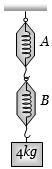
A block of mass $4 \,kg$ is suspended through two light spring balances $A$ and $B$. Then $A$ and $B$ will read respectively
The frequency of a sound wave is $n$ and its velocity is $v$. If the frequency is increased to $4n,$ the velocity of the wave will be
The height $y$ and the distance $x$ along the horizontal plane of a projectile on a certain planet (with no surrounding atmosphere) are given by $y = (8t - 5{t^2})$ meter and $x = 6t\, meter$, where $t$ is in second. the angle with the horizontal at which the projectile was projected is
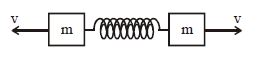
Two blocks each of mass $m$  are connected to a spring of spring constant $k.$  If both are given velocity $v$  in opposite directions, then the maximum elongation of the spring is
Young's modulus depends upon
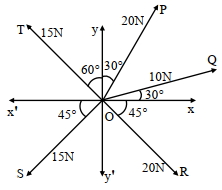
The resultant of these forces $\overrightarrow{O P}, \overrightarrow{O Q}, \overrightarrow{O R}, \overrightarrow{O S}$ and $\overrightarrow{{OT}}$ is approximately $\ldots \ldots {N}$.

[Take $\sqrt{3}=1.7, \sqrt{2}=1.4$ Given $\hat{{i}}$ and $\hat{{j}}$ unit vectors along ${x}, {y}$ axis $]$