Question
For the matrices A and B, verify that (AB)' = B'A' where
  1. $\text{A}=\begin{bmatrix}1\\-4\\3\end{bmatrix},\text{B}=\begin{bmatrix}-1&2&1\end{bmatrix}$
  2. $\text{A}=\begin{bmatrix}0\\1\\2\end{bmatrix},\text{B}=\begin{bmatrix}1&5&7\end{bmatrix}$
Answer

  1. $\text{AB}= \begin{bmatrix}1\\-4\\3\end{bmatrix}\begin{bmatrix}-1&2&1\end{bmatrix}=\begin{bmatrix}-1&2&1\\4&-8&-4\\-3&6&3\end{bmatrix}$
$\therefore\ \text{(AB)}'=\begin{bmatrix}-1&4&-3\\2&-8&6\\1&-4&3\end{bmatrix}$

Now, $\text{A}'=\begin{bmatrix}1&-4&3\end{bmatrix},\text{B}'=\begin{bmatrix}-1\\2\\1\end{bmatrix}$

$\therefore\ \text{B}'\text{A}'=\begin{bmatrix}-1&\\2\\1\end{bmatrix}\begin{bmatrix}1&-4&3\end{bmatrix}=\begin{bmatrix}-1&4&-3\\2&-8&6\\1&-4&3\end{bmatrix} $

Hence, we have verified that (AB)' = B'A'.
  1. $\text{AB}=\begin{bmatrix}0\\1\\2\end{bmatrix}\begin{bmatrix}1&5&7\end{bmatrix}=\begin{bmatrix}0&0&0\\1&5&7\\2&10&14\end{bmatrix}$
$\therefore\ \text{(AB)}'=\begin{bmatrix}0&1&2\\0&5&10\\0&7&14\end{bmatrix}$

Now, $\text{A}'=\begin{bmatrix}0&1&2\end{bmatrix},\text{B}'=\begin{bmatrix}1\\5\\7\end{bmatrix}$

$\therefore\ \text{B}'\text{A}'=\begin{bmatrix}1\\5\\7\end{bmatrix}\begin{bmatrix}0&1&2\end{bmatrix}=\begin{bmatrix}0&1&2\\0&5&10\\0&7&14\end{bmatrix}$

Hence, we have verified that (AB)' = B'A'.

Need a full question paper?

Generate a complete, print-ready paper with questions like this in minutes — across 16+ boards, with answer keys.

Start Generating Free

Similar questions

A factory has three machines X, Y and Z producing 1000, 2000 and 3000 bolts per day respectively. The machine X produces 1% defective bolts, Y produces 1.5% and Z produces 2% defective bolts. At the end of a day, a bolt is drawn at random and is found to be defective. What is the probability that this defective bolt has been produced by machine X?
Find the vector equation of a line passing through the point with position vector $\hat{\text{i}}-2\hat{\text{j}}-3\hat{\text{k}}$ and parallel to the line joining the points with position vectors $\hat{\text{i}}-\hat{\text{j}}+4\hat{\text{k}}$ and $2\hat{\text{i}}+\hat{\text{j}}+2\hat{\text{k}}.$ Also, find the cartesian equivalent of this equation.
Show that the three lines with direction cosines $\frac{12}{13},\frac{-3}{13},\frac{-4}{13},\frac{4}{13},\frac{12}{13},\frac{3}{13},\frac{3}{13},\frac{-4}{13},\frac{12}{13}$ are mutually perpendicular.
If $\text{xy}=1,$ prove that $\frac{\text{dy}}{\text{dx}}+\text{y}^2=0$
Evaluate the following integrals:
$\int_{0}^\limits{1}\text{x}\tan^{-1}\text{x}\text{ dx} $
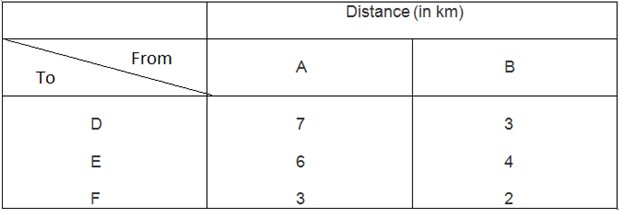
An oil company has two depots, $A$ and $B$, with capacities of $7000$ litres and $4000$ litres respectively. The company is to supply oil to three petrol pumps, $D, E, F$ whose requirements are $4500, 3000$ and $3500$ litres respectively. The distance (in km) between the depots and petrol pumps is given in the following table:

Assuming that the transportation cost per km is Rs. $1.00$ per litre, how should the delivery be scheduled in order that the transportation cost is minimum?
Evaluate the following:
$\begin{vmatrix}0&\text{xy}^2&\text{xz}^2\\\text{x}^2\text{y}&0&\text{yz}^2\\\text{x}^2\text{z}&\text{zy}^2&0\end{vmatrix}$
Evaluate the following integrals:
$\int_{0}^\limits{\pi}\frac{1}{3+2\sin\text{x}+\cos\text{x}}\text{ dx}$
Evaluate the following integrals:
$\int_{0}^\limits{\frac{\pi}{2}}\frac{\text{x}+\sin\text{x}}{1+\cos\text{x}}\text{ dx}$
Use product $\begin{bmatrix} 1 & -1 & 2 \\ 0 & 2 & -3 \\ 3 & -2 & 4 \end{bmatrix}\begin{bmatrix} -2 & 0 & 1 \\ 9 & 2 & -3 \\ 6 & 1 & -2 \end{bmatrix}$ to solve the system of equations x + 3z = 9, –x + 2y – 2z = 4, 2x – 3y + 4z = –3.