MCQ
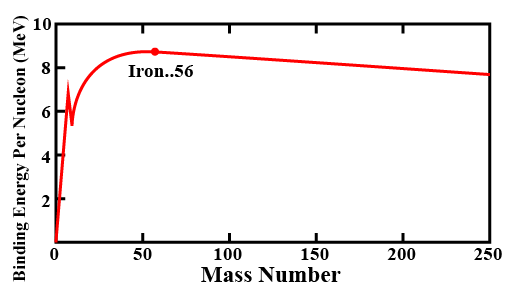
For the nuclie with mass number > 100:
  • A
    Binding energy of the nucleus decreases on an average as A increases.
  • B
    Binding energy of the nucleus increases on an average as A increases.
  • C
    The two nuclei fuse to form a bigger nuclide releasing energy.
  • D
    The nucleus essentially breaks up into two nuclides of equal mass releasing energy.
Answer

  1. Binding energy of the nucleus decreases on an average as A increases.

Explanation:

From the above figure it is clearly visible that the binding energy of the nucleus decreases on an average as A increases

Need a full question paper?

Generate a complete, print-ready paper with questions like this in minutes — across 16+ boards, with answer keys.

Start Generating Free

Similar questions

When the electron in a H-atom jumps from 6th excited state to 2nd excited state, the maximum number of emission lines will be.
When dipole moment $\vec{p}$ is parallel to nonuniform electric field $\vec{E}$, Net force on electric dipole is ___________ .
Work required to give displacement of $x$ to a unit positive charge on an equipotential surface is __________ .
Ideal $P - N$ junction can be used :
The frequency of incident light falling on a photosensitive metal plate is doubled, the kinetic energy of the emitted photoelectrons is.

Dynamo is a device for converting

(a) Electrical energy into mechanical energy

(b) Mechanical energy into electrical energy

(c) Chemical energy into mechanical energy

(d) Mechanical energy into chemical energy

For the myopic eye, the defect is cured by


(a) Convex lens

(b) Concave lens 

(c) Cylindrical lens

(d) Toric lens 

The maximum current that can be measured by a galvanometer of resistance 40 W is 10 mA. It is converted into a voltmeter that can read upto 50 V. The resistance to be connected in series with the galvanometer is ... (in ohm)


(a) 5040  

(b) 4960

(c) 2010  

(d) 4050

A wire has resistance 12 Ω. It is bent in the form of a circle. The effective resistance between the two points on any diameter is equal to

(a) 12 Ω  

(b) 6 Ω

(c) 3 Ω

(d) 24 Ω

On increasing the temperature of a conductor, its resistance increases because

(a) Relaxation time decreases

(b) Mass of the electrons increases

(c) Electron density decreases

(d) None of the above