Question
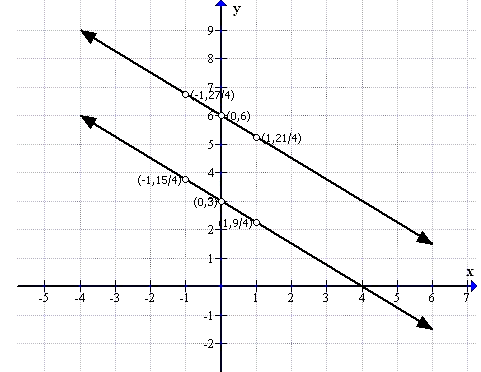
For the pair of linear equations given below, draw graphs and then state, whether the lines drawn are parallel or perpendicular to each other.$3x + 4y = 24,\frac{x}{4}+\frac{y}{3}=1$

Answer

To draw the graph of $3x + 4y = 24$ and $\frac{x}{4}+\frac{y}{3}=1$ follows the steps:
First prepare a table as below
$X$ $-1$ $0$ $1$
$Y=-\frac{3}{4} \times+6$ $\frac{27}{4}$ $6$ $\frac{21}{4}$
$Y=-\frac{3}{4} \times+3$ $\frac{15}{4}$ $3$ $\frac{9}{4}$
Now sketch the graph as shown:

From the graph it can verify that the lines are parallel.

Need a full question paper?

Generate a complete, print-ready paper with questions like this in minutes — across 16+ boards, with answer keys.
Start Generating Free

Similar questions

Evaluate the following without using tables :$\log_{10}8 + \log_{10}25 + 2 \log_{10}3 - \log_{10}18$
Prove that:
$\left(\frac{x^a}{x^b}\right)^{(a+b)} \cdot\left(\frac{x^b}{x^c}\right)^{(b+c)} \cdot\left(\frac{x^c}{x^a}\right)^{(c+a)}=1$
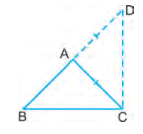
The sum of any two sides of a triangle is greater than its third side.
Given : A $\triangle ABC$.
To prove :
(i) $AB + AC > BC$
(ii) $AB + BC > AC$
(iii) $BC + AC > AB$.
Construction : Produce BA to D such that $AD = AC$. Join CD. Proof.
Image
$A (-2, 4),C(4, 10)$ and $D(-2, 10)$ are the vertices of a square $\text{ABCD}$. Use the graphical method to find the co$-$ordinates of the fourth vertex $B$. Also, find:$(i)$ The co$-$ordinates of the mid$-$point of $BC;(ii)$ The co$-$ordinates of the mipd$-$oint of $CD$ and $(iii)$ The co$-$ordinates of the point of intersection of the diagonals of the square $\text{ABCD}.$
The area of cross section of a pipe is $5.4$ square / cm and water is pumped out of it at the rate of $27\ km$ per hour. Find, in litres, the volume of water which flows out of the pipe in $2$ minutes.
In parallelogram $\text{ABCD, E}$ and $F$ are mid$-$points of the sides $AB$ and $CD$ respectively. The line segments $AF$ and $BF$ meet the line segments $ED$ and $EC$ at points $G$ and $H$ respectively.Prove that$:(i)$ Triangles $HEB$ and $FHC$ are congruent$;(ii)\text{GEHF}$ is a parallelogram.
Evaluate the following:$\sqrt{\frac{1}{4}}+(0.01)^{-\frac{1}{2}}-(27)^{\frac{2}{3}}$
A two$-$digit number is such that the ten’s digit exceeds twice the unit’s digit by $2$ and the number obtained by inter$-$changing the digits is $5$ more than thethesum of the digits. Find the two digit number.
Image
In the given figure, the area enclosed between two concentric circles is 808.5 $cm ^2$. The circumference of the outer circle is 242 cm.
Calculate : (i) the radius of the inner circle,
(ii) the width of the ring.
[Hint. $2 \times \frac{22}{7} \times R=242 \Rightarrow R=\frac{77}{2} cm$.$
\left.\frac{22}{7} \times\left(R^2-r^2\right)=\frac{8085}{10} \Rightarrow\left(R^2-r^2\right)=\frac{1029}{4} .\right]
$
Solve the following systems of equations by using the method of cross multiplication:
x + 2y + 1 = 0, 2x - 3y = 12