MCQ
For the reaction , $A + B \to 2C + D$ which one is the incorrect statement ?
  • A
    Rate of disappearance of $A =$ Rate of disappearance of $B$
  • B
    Rate of disappearance of $A =$ Rate of appearance of $D$
  • Rate of disappearance of $B = 2 \times $ Rate of appearance of $C$
  • D
    Rate of disappearance of $B = 1/2 \times $ rate of appearance of $C$
Answer

Correct option: C.
Rate of disappearance of $B = 2 \times $ Rate of appearance of $C$
c
R.O.R.$ =  - \frac{{{\text{d}}[{\text{A}}]}}{{{\text{dt}}}} =  - \frac{{{\text{d}}[{\text{B}}]}}{{{\text{dt}}}}$ $ = \frac{1}{2}\frac{{{\text{d}}[{\text{C}}]}}{{{\text{dt}}}} = \frac{{{\text{d}}[{\text{D}}]}}{{{\text{dt}}}}$

R.O.D. of  ${\text{A}} =  - \frac{{{\text{d}}[{\text{A}}]}}{{{\text{dt}}}}$

R.O.D. of  $\mathrm{B}=-\frac{\mathrm{d}[\mathrm{B}]}{\mathrm{dt}}$

R.O.A. of $C=\frac{d[C]}{d t}$

R.O.A. of $D=\frac{d[D]}{d t}$

Need a full question paper?

Generate a complete, print-ready paper with questions like this in minutes — across 16+ boards, with answer keys.

Start Generating Free

Similar questions

Evaluate the following statements related to group 14 elements for their correctness.
(A) Covalent radius decreases down the group from C to Pb in a regular manner.
(B) Electronegativity decreases from C to Pb down the group gradually.
(C) Maximum covalence of C is 4 whereas other elements can expand their covalence due to presence of d orbitals.
(D) Heavier elements do not form $p \pi$-p $\pi$ bonds.
(E) Carbon can exhibit negative oxidation states. Choose the correct answer from the options given below:
$2$ $mol$ of ${N_2}$ is mixed with $6$ $mol$ of ${H_2}$ in a closed vessel of one litre capacity. If $50\%$ of ${N_2}$ is converted into $N{H_3}$ at equilibrium, the value of ${K_c}$ for the reaction ${N_{2(g)}} + 3{H_{2(g)}}$ $\rightleftharpoons$ $2N{H_{3(g)}}$ is
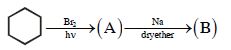
Product $B$ is
If phosphoric acid is allowed to react with sufficient quantity of $NaOH$, the product obtained is
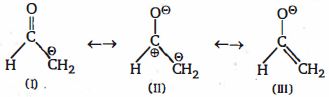
The correct order of stability for the given canonical structures is
${O_3}$ reacts with $C{H_2} = C{H_2}$ to form ozonide. On hydrolysis it forms
The following reaction occurs in the Blast furnance where iron ore is reduced to iron metal

$\mathrm{Fe}_2 \mathrm{O}_{3(\mathrm{~s})}+3 \mathrm{CO}_{(\mathrm{g})} \rightleftharpoons \mathrm{Fe}_{(1)}+3 \mathrm{CO}_{2(\mathrm{~g})}$

Using the Le-chatelier's principle, predict which one of the following will not disturb the equilibrium.

Which of the following molecules does not possess a permanent dipole moment
In the reaction ${H_2}S + N{O_2} \to {H_2}O + NO + S $ , ${H_2}S$ is
Which of the following is a disaccharide