Question
For the same speed, de Broglie wavelength.

Answer

  1. All of the above

Need a full question paper?

Generate a complete, print-ready paper with questions like this in minutes — across 16+ boards, with answer keys.
Start Generating Free

Similar questions

According to Bohr's theory, the electron in orbits have definite energy values, then according to uncertainty principle, the life time of an excited state will be:
In Young's double slit experiment, a glass plate is placed before a slit which absorbs half the intensity of light. Under this case(a) The brightness of fringes decreases(b) The fringe width decreases(c) No fringes will be observed(d) The bright fringes become fainter and the dark fringes have finite light intensity


An electric field $\overrightarrow{\text{E}}$ and a magnetic field $\overrightarrow{\text{B}}$ exist in a region. The fields are not perpendicular to each other.
  1. This is not possible.
  2. No electromagnetic wave is passing through the region.
  3. An electromagnetic wave may be passing through the region.
  4. An electromagnetic wave is certainly passing through the region.
One brass plate is inserted between two charges. The force between two charges will:
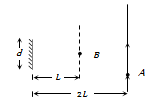
A point source of light $B$ is placed at a distance $L$ in front of the centre of a mirror of width $d$ hung vertically on a wall. $A$ man walks in front of the mirror along a line parallel to the mirror at a distance $2L$ from it as shown. The greatest distance over which he can see the image of the light source in the mirror is
Two cars of unequal masses use similar tyres. If they are moving at the same initial speed, the minimum stopping distance:
X-ray incident on a material:
When the conductivity of a semiconductor is only due to breaking of covalent bonds, the semiconductor is called:
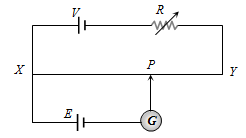
A potentiometer circuit shown in the figure is set up to measure e.m.f. of a cell $E.$ As the point $P$ moves from $X$ to $Y$ the galvanometer $G$ shows deflection always in one direction, but the deflection decreases continuously until $Y$ is reached. In order to obtain balance point between $X$ and $Y$ it is necessary to
The current in a conductor varies with time $t$ as $I= 2t+3t^2$ where I is in ampere and t in seconds.  Electric charge flowing through a section of the conductor during $t = 2 \sec$ to $t = 3 \sec$ is