MCQ
For the system $A_{(g)} + 2B_{(g)}$ $\rightleftharpoons$ $C_{(g)}$, the equilibrium concentrations are $(A) 0.06$ mole/litre $(B) 0.12$ mole/litre $(C) 0.216$ mole/litre. The ${K_{eq}}$ for the reaction is
  • $250$
  • B
    $416$
  • C
    $4 \times {10^{ - 3}}$
  • D
    $125$

Answer

Correct option: A.
$250$
(a) For reaction $A + 2B$ $ \rightleftharpoons $ $ C$

$K = \frac{{[C]}}{{[A]\,\,{{[B]}^2}}} = \frac{{0.216}}{{0.06 \times 0.12 \times 0.12}} = 250$.

Need a full question paper?

Generate a complete, print-ready paper with questions like this in minutes — across 16+ boards, with answer keys.

Start Generating Free

Similar questions

Which of the following condition will increase the voltage of the cell, represented by the equation $C{u_{(s)}} + 2A{g^ + }_{(aq)} \to C{u^{2 + }}_{(aq)} + 2A{g_{(s)}}$
Ether is formed when ethyl alcohol is heated with conc. ${H_2}S{O_4}.$ The conditions are
Electricity do not pass through ionic compounds
The total number of correct statements, regarding the nucleic acids is..............।

$A. RNA$ is regarded as the reserve of genetic information.

$B. DNA$ molecule self-duplicates during cell division

$C. DNA$ synthesizes proteins in the cell.

$D$. The message for the synthesis of particular proteins is present in $DNA$

$E$. Identical $DNA$ strands are transferred to daughter cells.

A photon of wavelength $6630\  \mathop A\limits^o $  is incident on a totally reflecting surface. The momentum delivered by the photon is equal to
In $O_2^-$ , $O_2$ and $O_2^{2-}$ , the total number of antibonding electrons respectively are
Which of following gives Fehling solution test ?
$\begin{array}{*{20}{c}}
  {C{H_3} - CH - CH - C{H_3}} \\ 
  {\,\,|\,\,\,\,\,\,\,\,\,\,\,\,\,\,\,|\,\,\,\,\,\,\,} \\ 
  {Cl\,\,\,\,\,\,\,\,\,\,\,Cl\,\,\,} 
\end{array}$ $\xrightarrow[dry\,ether]{Na}X\xrightarrow[\left( 2 \right)\,{{H}_{2}}{{O}_{2}},\overset{\Theta }{\mathop{O}}\,{{H}_{\left( aq \right)}}]{\left( 1 \right)\,B{{H}_{3}},THF}Y;\,Y$ is
Given below are two statements :
Statement I : The electronegativity of group 14 elements from Si to Pb gradually decreases.
Statement II : Group 14 contains non-metallic, metallic, as well as metalloid elements.
In the light of the above statements, choose the most appropriate from the options given below :
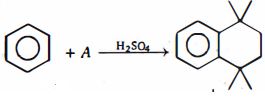
Reactant $(A)$ is