Question
For two matrices $A$ and $B, \text{A}=\begin{bmatrix}2&1&3\\4&1&0\end{bmatrix},\text{B}=\begin{bmatrix}1&-1\\0&2\\5&0\end{bmatrix}$ verify that $(AB)^T = B^TA^T$.

Answer

Given,
$\text{A}=\begin{bmatrix}2&1&3\\4&1&0\end{bmatrix},\text{B}=\begin{bmatrix}1&-1\\0&2\\5&0\end{bmatrix}$
$(\text{AB})^\text{T}=\text{B}^\text{T}\text{A}^\text{T}$
$\Rightarrow\begin{pmatrix}\begin{bmatrix}2&1&3\\4&1&0\end{bmatrix}\begin{bmatrix}1&-1\\0&2\\5&0\end{bmatrix}\end{pmatrix}^\text{T}$ $=\begin{bmatrix}1&-1\\0&2\\5&0\end{bmatrix}^\text{T}\begin{bmatrix}2&1&3\\4&1&0\end{bmatrix}^\text{T}$
$\Rightarrow\begin{bmatrix}2+0+15&-2+20\\4+0+0&-4+2+0\end{bmatrix}^\text{T}$ $=\begin{bmatrix}1&0&5\\-1&2&0\end{bmatrix}\begin{bmatrix}2&4\\1&1\\3&0\end{bmatrix}$
$\Rightarrow\begin{bmatrix}17&0\\4&-2\end{bmatrix}^\text{T}=\begin{bmatrix}2+0+15&4+0+0\\-2+2+0&-4+2+0\end{bmatrix}$
$\Rightarrow\begin{bmatrix}17&4\\0&-2\end{bmatrix}=\begin{bmatrix}17&4\\0&-2\end{bmatrix}$
$\Rightarrow\text{LHS}=\text{RHS}$
So,
$(\text{AB})^\text{T}=\text{B}^\text{T}\text{A}^\text{T}$

Need a full question paper?

Generate a complete, print-ready paper with questions like this in minutes — across 16+ boards, with answer keys.
Start Generating Free

Similar questions

Evaluate the following integrals:
$\int^\limits{2}_{1}|\text{x}-3|\text{dx}$
Evalute the following integrals:
$\int\frac{1+\tan\text{x}}{1-\tan\text{x}}\text{dx}$
Evaluate the following integrals:$\int\frac{\sin\text{x}-\cos\text{x}}{\sqrt{\sin2\text{x}}}\text{ dx}$
A card is drawn from a well-shuffled deck of 52 cards and then a second card is drawn. Find the probability that the first card is a heart and the second card is a diamond if the first card is not replaced.
Three machines $E_1, E_2, E_3$ in a certain factory produce $50\%, 25\%$ and $25\%,$ respectively, of the total daily output of electric bulbs. It is known that $4\%$ of the tubes produced one each of the machines $E_{1 }$ and $E_2$ are defective, and that $5\%$ of those produced on $E_3$ are defective. If one tube is picked up at random from a day's production, then calculate the probability that it is defective.
Ten cards numbered 1 through 10 are placed in a box, mixed up thoroughly and then one card is drawn randomly. If it is known that the number on the drawn card is more than 3, what is the probability that it is an even number?
Find $\frac{\text{dy}}{\text{dx}}$ of the functions given in Exercise:
$\text{xy}=\text{e}^{(\text{x}-\text{y})}$
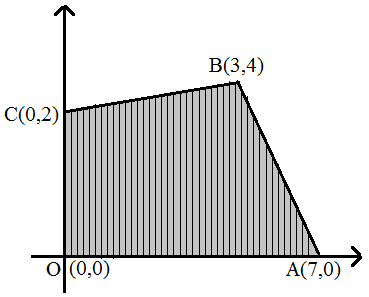
Feasible region (shaded) for a LPP is shown in Maximise Z = 5x + 7y.
Give an example of a relation which is,
Reflexive and symmetric but not transitive.
For the following differntial equations verify that the accompanying function is a solution:
Differential equation Function
$\text{x}+\text{y}\frac{\text{dy}}{\text{dx}}=0$ $\text{y}=\pm\sqrt{\text{a}^2-\text{x}^2}$