Question
For two statements are given-one labelled Assertion (A) and the other labelled Reason (R). Select the correct answer to these questions from the codes (a), (b), (c) and (d) as given below.
  1. Both A and R are true, and R is the correct explanation of A.
  2. Both A and R are true, but R is not the correct explanation of A.
  3. A is true but R is false.
  4. A is false and R is also false.
Assertion (A): For charge to be in equilibrium, sum of the forces on charge due to rest of the two charges must be zero.
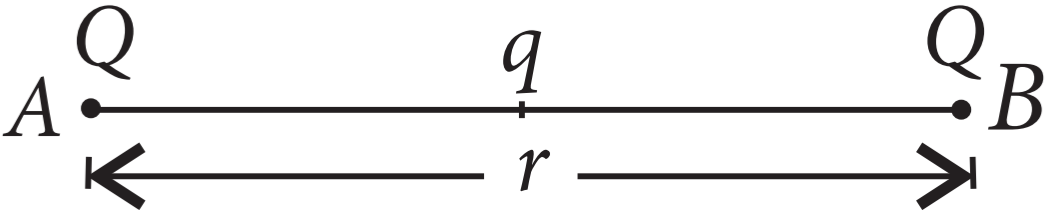
Reason (R): A charge is lying at the centre of the line joining two similar charges each which are fixed. The system will be in equilibrium if that charge is one fourth of the similar charges.
Answer

  1. A is true but R is false.

Explanation:

According to Coulomb's law, $\text{F}=\text{k}\frac{\text{Q}_1\text{Q}_2}{\text{r}^2}.$

The force on q due to A,

$\text{F}_\text{A}=\frac{1}{4\pi\in_0}\cdot\frac{\text{Qq}}{(\frac{\text{r}}{2})^2}$ to the right

Due to B,

$\text{F}_\text{B}=\frac{1}{4\pi\in_0}\cdot\frac{\text{Qq}}{(\frac{\text{r}}{2})^2}$ to the right

$\therefore$ Their sum is zero whether q is $+\frac{\text{Q}}{4}$or $-\frac{\text{Q}}{4}$ or any other value.

Therefore, it is not true that the third charge has to be $\frac{\text{Q}}{4}$ only. It can be any value.

Need a full question paper?

Generate a complete, print-ready paper with questions like this in minutes — across 16+ boards, with answer keys.

Start Generating Free

Similar questions

Two statements are given-one labelled Assertion (A) and the other labelled Reason (R). Select the correct answer to these questions from the codes (a), (b), (c) and (d) as given below.
  1. Both A and R are true and R is the correct explanation of A.
  2. Both A and R are true but R is not the correct explanation of A.
  3. A is true but R is false.
  4. A is false and R is also false.
Assertion: A convex lens is made of two different materials. A point object is placed on the principal axis. The number of images formed by the lens will be two.
Reason: The image formed by convex lens is always virtual.
Two statements are given-one labelled Assertion (A) and the other labelled Reason (R). Select the correct answer to these questions from the codes (a), (b), (c) and (d) as given below.
  1. Both A and R are true and R is the correct explanation of A.
  2. Both A and R are true but R is not the correct explanation of A.
  3. A is true but R is false.
  4. A is false and R is also false.
Assertion: Endoscopy involves use of optical fibres to study intemal organs.
Reason: Optical fibres are based on phenomena of total internal reflection.
For question two statements are given-one labelled Assertion (A) and the other labelled Reason (R). Select the correct answer to these questions from the codes (a), (b), (c) and (d) as given below.

  1. Both A and R are true, and R is the correct explanation of A.
  2. Both A and R are true, but R is NOT the correct explanation of A.
  3. A is true, but R is false.
  4. A is false and R is also false.

Assertion (A): Fraunhofer lines are observed in the spectrum of the sun.

Reason (R): The different elements have different spectra.

For two statements are given-one labelled Assertion (A) and the other labelled Reason (R). Select the correct answer to these questions from the codes (a), (b), (c) and (d) as given below.
  1. Both A and R are true, and R is the correct explanation of A.
  2. Both A and R are true, but R is not the correct explanation of A.
  3. A is true, but R is false.
  4. A is false, and R is also false.
Assertion: Chemical reactions involved in primary cells are irreversible and in secondary cells are reversible.
Reason: Primary cells can be recharged, but secondary cells can not be recharged.
For two statements are given-one labelled Assertion (A) and the other labelled Reason (R). Select the correct answer to these questions from the codes (a), (b), (c) and (d) as given below.
  1. Both A and R are true, and R is the correct explanation of A.
  2. Both A and R are true, but R is not the correct explanation of A.
  3. A is true, but R is false.
  4. A is false, and R is also false.
Assertion: The current in a wire is due to flow of free electrons in a definite direction.
Reason: A current carrying wire should have non-zero charge.
For question two statements are given-one labelled Assertion (A) and the other labelled Reason (R). Select the correct answer to these questions from the codes (a), (b), (c) and (d) as given below.
  1. Both A and R are true and R is the correct explanation of A.
  2. Both A and R are true but R is NOT the correct explanation of A.
  3. A is true but R is false.
  4. A is false and R is also false.
Assertion (A): ln YDSE bright and dark fringe are equally spaced.
Reason (R): It only depends upon phase difference.
For two statements are given-one labelled Assertion (A) and the other labelled Reason (R). Select the correct answer to these questions from the codes (a), (b), (c) and (d) as given below.
  1. Both A and R are true, and R is the correct explanation of A.
  2. Both A and R are true, but R is not the correct explanation of A.
  3. A is true but R is false.
  4. A is false and R is also false.
Assertion (A): No two electric lines of force can intersect each other.
Reason (R): Tangent at any point of electric line of force gives the direction of electric field.
Two statements are given-one labelled Assertion (A) and the other labelled Reason (R). Select the correct answer to these questions from the codes (a), (b), (c) and (d) as given below.
  1. Both A and R are true and R is the correct explanation of A.
  2. Both A and R are true but R is not the correct explanation of A.
  3. A is true but R is false.
  4. A is false and R is also false.
Assertion: Light is a transverse wave but not an electromagnetic wave.
Reason: Maxwell showed that speed of electromagnetic waves is related to the permittivity of the medium through which it travels.
For question two statements are given-one labelled Assertion (A) and the other labelled Reason (R). Select the correct answer to these questions front the codes (a), (b), (c) and (d) as given below.
  1. Both A and R are true and R is the correct explanation of A.
  2. Both A and R are true but R is NOT the correct explanation of A.
  3. A is true but R is false.
  4. A is false and R is also false.
Assertion (A): Some photographic plates are not affected by red light but are immediately blackened by white light.
Reason (R): The wavelength of red light is less than the wavelength of many components of white light.
Two statements are given-one labelled Assertion (A) and the other labelled Reason (R). Select the correct answer to these questions from the codes (a), (b), (c) and (d) as given below.
  1. Both A and R are true and R is the correct explanation of A.
  2. Both A and R are true but R is not the correct explanation of A.
  3. A is true but R is false.
  4. A is false and R is also false.
Assertion: Light can travel in vacuum whereas sound cannot do so.
Reason: Light has an electromagnetic wave nature whereas sound is mechanical wave.