Question
For two statements are given-one labelled Assertion (A) and the other labelled Reason (R). Select the correct answer to these questions from the codes (a), (b), (c) and (d) as given below.
  1. Both A and R are true and R is the correct explanation of A.
  2. Both A and R are true but R is not the correct explanation of A.
  3. A is true but R is false.
  4. A is false and R is also false.
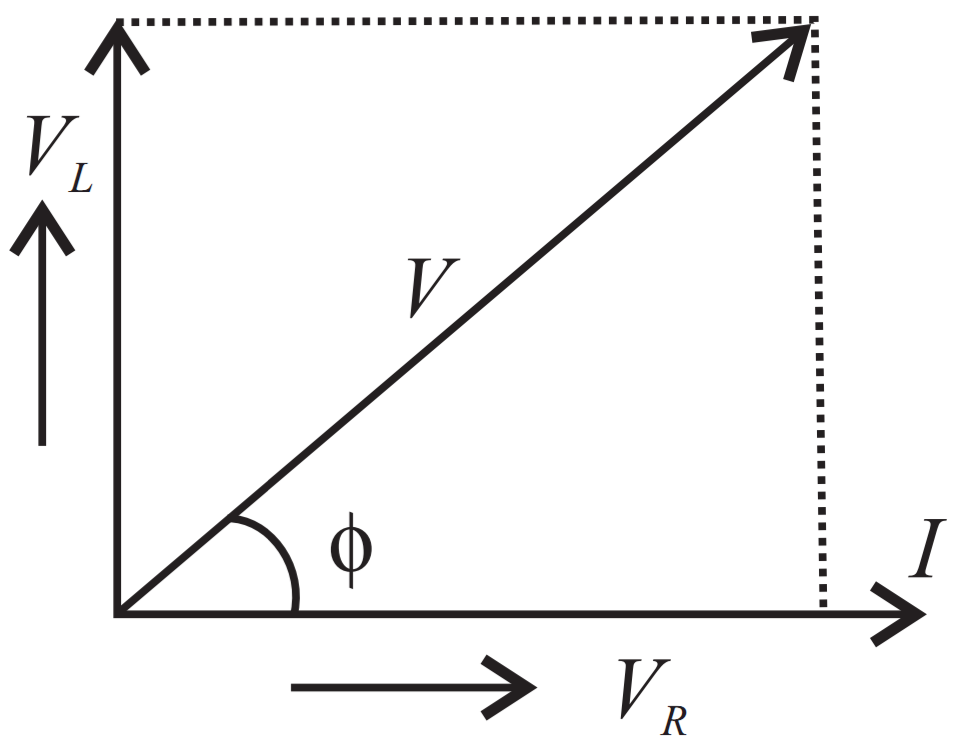
Assertion: An inductance and a resistance are connected in series with an A.C. circuit. ln this circuit the current and the potential difference across the resistance lags behind potential difference across the inductance by an angle $\frac{\pi}{2}.$
Reason: In L-R circuit voltage leads the current by phase angle which depends on the value ofinductance and resistance both.
Answer

  1. Both A and R are true but R is not the correct explanation of A.

Explanation:

As both the inductance and resistance are joined in series, hence current through both will be same. But in case of resistance, both the current and potential vary simultaneously, hence they are in same phase. While in case of an inductance when current is zero, potential difference across it is maximum and when current reaches maximum $\big($at $\omega\text{t}=\frac{\pi}{2}\big),$ potential difference across it becomes zero i.e., potential difference leads the current by $\frac{\pi}{2}$ or current lags behind the potential difference by $\frac{\pi}{2}.$ Phase angle in case of LR circuit is given as $\phi=\tan^{-1}\Big(\frac{\omega\text{L}}{\text{R}}\Big).$

Need a full question paper?

Generate a complete, print-ready paper with questions like this in minutes — across 16+ boards, with answer keys.

Start Generating Free

Similar questions

Two statements are given-one labelled Assertion (A) and the other labelled Reason (R). Select the correct answer to these questions from the codes (a), (b), (c) and (d) as given below.
  1. Both A and R are true and R is the correct explanation of A.
  2. Both A and R are true but R is not the correct explanation of A.
  3. A is true but R is false.
  4. A is false and R is also false.
Assertion: Velocity of light is constant in all media.
Reason: Light is an electromagnetic wave which has constant velocity in all media.
For two statements are given-one labelled Assertion (A) and the other labelled Reason (R). Select the correct answer to these questions from the codes (a), (b), (c) and (d) as given below.
  1. Both A and R are true, and R is the correct explanation of A.
  2. Both A and R are true, but R is not the correct explanation of A.
  3. A is true, but R is false.
  4. A is false, and R is also false.
Assertion (A): Electric potential of the earth is zero.
Reason (R): The electric field due to the earth is zero.
Two statements are given-one labelled Assertion (A) and the other labelled Reason (R). Select the correct answer to these questions from the codes (a), (b), (c) and (d) as given below.
  1. Both A and R are true and R is the correct explanation of A.
  2. Both A and R are true but R is NOT the correct explanation of A.
  3. A is true but R is false.
  4. A is false and R is also false.
Assertion (A): When a charged particle moves perpendicular to magnetic field then its kinetic energy and momentum gets affected.
Reason (R): Force changes velocity of charged particle.
For two statements are given-one labelled Assertion (A) and the other labelled Reason (R). Select the correct answer to these questions from the codes (a), (b), (c) and (d) as given below.
  1. Both A and R are true, and R is the correct explanation of A.
  2. Both A and R are true, but R is not the correct explanation of A.
  3. A is true but R is false.
  4. A is false and R is also false.
Assertion (A): Three equal charges are situated on a circle of radius r such that they form on equilateral triangle, then the electric field intensity at the centre is zero.
Reason (R): The force on unit positive charge at the centre, due to the three equal charges are represented by the three sides of a triangle taken in the same order. Therefore, electric field intensity at centre is zero.
For question two statements are given-one labelled Assertion (A) and the other labelled Reason (R). Select the correct answer to these questions from the codes (a), (b), (c) and (d) as given below.
  1. Both A and R are true and R is the correct explanation of A.
  2. Both A and R are true but R is NOT the correct explanation of A.
  3. A is true but R is false.
  4. A is false and R is also false.
Assertion (A): ln YDSE bright and dark fringe are equally spaced.
Reason (R): It only depends upon phase difference.
For question, statements are given-one labelled Assertion (A) and the other labelled Reason (R). Select the correct answer to these questions from the codes (a) (b) (c) and (d) as given below.

  1. Both A and R are true, and R is the correct explanation of A.
  2. Both A and R are true, but R is NOT the correct explanation of A.
  3. A is true, but R is false.
  4. A is false and R is also false.

Assertion (A): For the fission of heavy nuclei, neutrons are more effective than protons.

Reason (R): Neutrons are heavier than protons.

Two statements are given-one labelled Assertion (A) and the other labelled Reason (R). Select the correct answer to these questions from the codes (a), (b), (c) and (d) as given below.
  1. Both A and R are true and R is the correct explanation of A.
  2. Both A and R are true but R is not the correct explanation of A.
  3. A is true but R is false.
  4. A is false and R is also false.
Assertion: The images formed by total intemal reflections are brighter than those formed by mirrors or lenses.
Reason: There is no loss of intensity in total internal reflection.
For two statements are given-one labelled Assertion (A) and the other labelled Reason (R). Select the correct answer to these questions from the codes (a), (b), (c) and (d) as given below.
  1. Both A and R are true, and R is the correct explanation of A.
  2. Both A and R are true, but R is not the correct explanation of A.
  3. A is true, but R is false.
  4. A is false, and R is also false.
Assertion (A): An applied electric field will polarize the polar dielectric material.
Reason (R): In polar dielectrics, each molecule has a permanent dipole moment but these are randomly oriented in the absence of an externally applied electric field.
For question two statements are given-one labelled Assertion (A) and the other labelled Reason (R). Select the correct answer to these questions from the codes (a), (b), (c) and (d) as given below.
  1. Both A and R are true and R is the correct explanation of A.
  2. Both A and R are true but R is NOT the correct explanation of A.
  3. A is true but R is false.
  4. A is false and R is also false.
Assertion (A): One of the condition for interference is that the two source should be very narrow.
Reason (R): One broad source is equal to large number of narrow sources.
For question two statements are given-one labelled Assertion (A) and the other labelled Reason (R). Select the correct answer to these questions front the codes (a), (b), (c) and (d) as given below.
  1. Both A and R are true and R is the correct explanation of A.
  2. Both A and R are true but R is NOT the correct explanation of A.
  3. A is true but R is false.
  4. A is false and R is also false.
Assertion (A): The de-Broglie wavelength of a neutron when its kinetic energy is K is $\lambda$. Its wavelength is $2\lambda$, when its kinetic energy is 4K.
Reason (R): The de-Broglie wavelength $\lambda$ is directly proportional to square root of the kinetic energy.